
Here’s a DevOps 101 presentation based on the definition of DevOps here at The Agile Admin I’m delivering at Innotech San Antonio tomorrow as part of a devops.com attempt to spread DevOps learning to IT and the enterprise. (You probably want to go view it on slideshare.com so you can read the notes, too…)
Tag Archives: DevOps
Awesome Upcoming Austin Techie Events
We’re entering cool event season… I thought I’d mention a bunch of the upcoming major events you may want to know about!
- Product Camp Austin, Saturday March 7 (free), for product management types
- Puppet Camp Austin, Tuesday March 10 ($50), for Puppet users
- SXSW Interactive, March 13-17 ($1295)
- Container Days Austin, Friday evening March 27 and Saturday March 28 ($60), for docker, CoreOS, and containerization fanatics.
- DevOpsDays Austin 2015, Monday May 4-Tuesday May 5 ($120), for lovers of DevOps. Sponsorships and call for presenters are also open.
- Keep Austin Agile 2015 – Friday May 8 ($285), for Agilists of all stripes.
In terms of repeating meetings you should be going to,
- CloudAustin – Evening meeting every 3rd Tuesday at Rackspace for cloud and related stuff aficionados! Large group, usually presentations with some discussion.
- Agile Austin DevOps SIG – Lunchtime discussion, Lean Coffee style, at BancVue about DevOps. Sometimes fourth Wednesdays, sometimes not. There are a lot of other Agile Austin SIGs and meetings as well.
- Austin DevOps – Evening meetup all about DevOps. Day and location vary.
- Docker Austin – First Thursday evenings at Rackspace, all about docker.
- Product Austin – Usually early in the month at Capital Factory. Product management!
Filed under DevOps
Scrum for Operations: Just Add DevOps
OK, so it’s been a while since the last installment in this series. I had talked about how we’d brought Scrum to our operations team, which worked fine, and then added in the developers as well, which didn’t. Our first attempt at dividing the whole product up into four integrated DevOps service teams collapsed quickly. Here’s how we got past that to do it again and succeed, with a fully integrated DevOps setup managing both proactive/project/feature work and reactive/support/tactical work in an effective way.
The first challenge we had was just that I couldn’t manage four new scrum teams totally on my own. We had gotten the ops team working well on Scrum but the development team hadn’t been. We didn’t have any scrum masters other than me, and were low on people designated as tech leads as well. So step one, we just mushed everyone into a 30+-person Scrum team, which sucked but was the least of the evils, and I immediately worked on mentoring people up as both Scrum masters and tech leads. I basically led by example and asked for volunteers for who was interested in Scrum mastering and/or being a tech lead for each of the planned sub-teams.
This was interesting – people self-selected in ways I would not have predicted. Some of the willing were employees and others were contractors – fine, as far as I’m concerned. “From each according to his ability, to each according to his need.” I then maximally had them start to lead standups and take ownership over sprints and such, coaching them in the background. In that way, it only took a little while to re-form up into those four teams. This gave some organic burn-in time as well, so that the ops folks got more used to not being “the ops team” and leaning on people that were supposed to be on other sprint teams. As I empowered the new leaders this became self-correcting (“Stop working with that other guy on their stuff, we have things that need doing for our service!”).
The second and largest problem was managing the work.
Part 1: “Planned” Work
Product Management
We had practically zero product manager support at the beginning, so it was up to us to try to balance planned work from many sectors – feature requests from PM, tooling requests from Customer Service and Technical Support, security stuff from Security, random requests from Legal and Compliance, brainwaves from other products’ engineering managers. It quickly began to take a full person worth of time to handle, because if not managed proactively it turned into attending meetings with people complaining as a reactive result. I went to the PM team and said “come on man, give us more PM support,” and once we got one, I worked with her on being able to manage the whole overall package.
One of the chronic product manager problems in a SaaS environment is the “not my domain” syndrome. PMs want to talk about features, but when it comes to balancing stakeholders like Security and internal operational projects, they wash their hands of it. At best you get a “Well… You guys get 50% of your time to figure out what to do with that stuff and then 50% of your bandwidth will be my features, OK?”
For the record, that’s not OK. As a product manager, you need to be able to balance all the work against all the work. Maybe you don’t have an ops background, that’s fine – you probably didn’t have a <business domain here> background when you came to work either. Learn. A lot of the success of a SaaS product is in the balancing of features against stability/scalability work against compliance work… If you want to take the “I’m the CEO of the product” role, then you need to step up and own all of it, otherwise you’re just that product’s Director of Wishful Thinking.
Anyway, luckily our PM, even though she didn’t have experience doing that, was willing to learn and take it on. So we could reason about spending a month putting in a new cluster versus adding a new display feature – they all went into the same roadmap.
Work Management in JIRA
We managed that in the standard, simple way of a quarterly spreadsheet roadmap correlating to epics in an Agile rapid board in JIRA; we’d do stakeholder meetings and stack rank them and then move them into the team backlogs and flesh them out when they were ready for execution. (It was important to keep the clutter out of the backlogs till then – even if it’s supposed to be future stuff, the more items sitting in a team’s backlog, the worse their focus is.)
We kept each service as one JIRA project but combined them into rapid boards as necessary – a given team might own a couple (like the “Workbench and CMS Team” had those two and a smaller tooling one). This way when we transferred a piece of tech around we could just move the JIRA project as well, and incorporate it into the target team’s rapid board.
Portfolio Management
Some people say that the ideal world is each team owning one microservice. I don’t agree with this – we had a number of teams under other parts of the org that were only like 2 people because they owned some little service. This was difficult to sustain and transition; when things like Black Friday came up that required 24×7 support from each team for a week it was brutal on them, and even worse once development eased up on a service it just got orphaned.
If you don’t keep a service portfolio and tightly manage who is tasked with supporting each one, you are opening yourself up to a world of hurt. And that’s where we started. Departmentwide, we’d have teams work on something and then wander off and if there was a problem they’d call on the dev who was somewhere working on some other deadline now. This worked terribly. I got the brunt of this earlier when I had joined the company as a release manager and asked “So, those core services, who owns those?” “Well… No one. I mean everyone!”
So for my teams, we put together a tracking list, used both as a service registry but also for cross-training. It was a simple three-level outline, with major services, service components, and low level elements. We had the whole team work together on filling out the list – since we were managing a 7-year-old legacy system we ended up with a list of 275 or so leaf items. Every one had to have an owning team (team, not individual), and unless you retired a service, there was no dropping it on the floor. You owned it, you retired or transitioned it, and I didn’t care if “the dev that worked on that moved to some other team.” Everything was included, from end user facing services like “the user portal” to internal services like our CI servers.
Team Management
This transitions into how we managed the teams. Teams were standard “two-pizza size” – a team of 5-7 people is optimal and we would combine services up till there was enough work for a team of that size. This avoided the poor coverage of mini-teams for micro-services.
Knowledge Management
Then we also used the service registry as the “merit badge system.” We had a simple qualification procedure – to get qualified in an element, you had to roll out code on it and you could sign off for yourself to say that you were qualified on one of those leaf elements. To get your “merit badge” in a service component, you needed an existing subject matter expert (SME) to sign off that you knew what you were doing, and you needed to understand how the service was written, deployed, tested, monitored. To become a SME in a service, the existing SMEs would have a board of review. SMEs were then understood to be qualified to make architectural changes on their own initiative, those with merit badges were understood to be qualified to make code changes with nothing more than the usual code review and CI testing.
This was very important for us because we were starting in a place where people had been allowed to specialize too much. Only one person was the SME on any given service and if the person who didn’t understand the Workbench was out, or quit, or whatever, suddenly no one knew a whole lot about it. That’s a terrible velocity burden even without attrition and it’s a clear and present danger to your service’s viability when there is. We started tracking the “merit badges” and had engineers set goals around how many they’d earn (or how many they’d review, for the more experienced). We used a lot of contract programmers and I told the contractor manager that I wanted to use that to rate the expertise of people on our account and that I wanted to see the numbers rise on each person over time.
Part 2 – “Unplanned” Work
Our team was only doing planned work 40% of the time, however. Since we were integrated DevOps teams working on a service with thousands of paying end customers, and that service was custom-integrated with customer Web sites and import/export of customer data, there was a continuous load of work coming in from Customer Support and from our own operations (alerts, etc.). All this “flow” work was interrupt-driven, and urgent to one degree or another.
The usual techniques for handling this have a lot of problems. “Let’s make a separate sustaining team!” Well, this turns into a set of second class developers. Thus you get worse devs there on that team. And those devs are more utilized one week, less the next; when things are quiet they get seconded to other efforts by people that haven’t read the Principles of Product Development Flow and think having everyone highly utilized is valuable, and then the load ramps up and something gives… Plans emerge to make it a training ground for new devs, till you realize that even new devs don’t want to put up with that and just quit… I’ve seen this happen in several places. I am a firm believer in dog fooding – if you are writing a service, you need to handle its problems. If there are a lot of problems, fix it!!! If you are writing the next version of the service – well, doing that in isolation from the previous service dooms you to making the same errors, adding in some new ones as well. No sustaining teams, only evergreen teams.
So we had the rule that each integrated team of devs and ops handled their own dirty laundry. And at 60% of the workload, that was a lot of laundry. How did we do it? Everyone was worried about how we could deliver decent feature velocity while overwhelmed by flow work. Therefore…
Triage
In addition to the teams’ daily standups, we had a daily triage meeting where the engineering manager, team leads, PM, and representatives from Support, Sales, and whoever had a crisis item that they felt needed to be handled on an expedited basis (not waiting on the next sprint, in other words) would come to. Each new intake would be reviewed. In the beginning we had to kick a lot of requests back for insufficient detail, but that corrected itself fast. We’d all agree on priority – “that’s affecting one customer but they’re one of our top customers, we’ll work it as P2” or the like.
For customer reported issues, we had SLAs we committed to in contracts (1 day for P1, etc). Ops issues could be super urgent – “P1, one of our services is down!” – or doable later on. So what we did was to create a separate Kanban board in JIRA for all these kinds of issues. Anything that really could wait or was large/long term would get migrated into the Scrum backlogs, but anything where “we need someone to do this stat” went in here. It served the same purpose as an “expedite lane,” it was just a jumbo four-lane highway of an expedite lane because so much of the work was interrupt driven.
But does this mean “give up on Scrum?” No. Without the sprint cadence it was hard to hit a release cadence, and also it was easy for engineers to just get lost in the soup and stop delivering at a good rate, frankly. So we still ran sprints, and here was the rules of engagement we provided the engineers.
Need More Work?
- Pull things for your team/service off the triage queue
- If there’s nothing in the triage queue, pull the next item from the sprint backlog
- If there’s nothing in the sprint backlog or the triage queue, pull something off the top of the backlog. Or relax, either one.
Then for standups, we had a master Agile board that contained everything – all projects, the triage board, everything. So when you looked at a given engineer’s swimlane, you could see the sprint work they had, the flow work they had, and anything they were working on from someone else’s project (“Hey, why are you doing that?”). Again, via JIRA agile board composition that’s easy to do. Sometimes teams would try to do standups just looking at swimlanes containing “their” projects and it always ended up with things falling in the gap, so each time that happened I reiterated the value of seeing everything that person is assigned, not just what you think/hope they are assigned, since they are exclusively attached to that one team.
At first, everyone fretted about the conflict between the flow work and the sprint work. “What if there’s a lot of support work today?!?” But as we went on sprint by sprint, it became evident that over the course of a two week sprint, the amount of support and operations work evened out. Sprint velocity was regular despite the team working flow work as well. Having full-sized sprint teams and two-week iterations meant that even if one day there was a big production issue and whoever grabbed it was slammed – over the rest of the time and people it evened out. This shouldn’t be too surprising, it’s called “flow” for a reason – there are small ebbs and surges but in general the amount over time at scale is the same. Was it as perfectly “efficient” as having some people working flow and others working sprints? No, there is definitely a % overhead that incurs. But maximum utilization of each person’s time, as I mentioned before, is a golden calf. Lean principles show us that we want the best overall outcome – and this worked.
Flow work was addressed quickly, and our customer ticket SLA attainment percentage whipped up from a starting level of less than 50% over several quarters to sit at 100%, meaning every single support ticket that came in was addressed within its advertised SLA. Once that number hit 100% the support ticket time to live started to fall as well.
At the same time, sprint velocity for each of the four sprint teams went up over time – that is, just the story points they were delivering out of the feature backlog improved, in addition to the improvements in flow work. We’d modify the process based on engineer feedback and try alterations for a sprint to see how they panned out, but in general by keeping the overall frame in place long enough that people got used to it, they became more and more productive. Flow work and planned work both improved at the same time, not at each others’ expense.
The Dynamic Duo
This scheme had two issues. One was that engineers were sometimes confused about what they should be working on, flow tickets with SLAs or their sprint tasks. Our Scrum masters were engineers on the teams too, they weren’t full time PMs that could afford to be manually managing everyone’s work. The second was that operational issues that came in and required sub-day response time couldn’t wait for triage and ended up with either frantic searches for anyone who could help (which often became “everyone sitting in the team area”) or missed items.
I have always been inspired by Tom Limoncelli’s Time Management for System Administrators. He advocates an “interrupt shield” where someone is designated as the person to handle walkups and crises. At NI I had instituted this in process, at BV in the previous Ops team there had been a “The Dude” role (complete with Jeff Bridges bobblehead) that had been that. Thus the Dynamic Duo were born.
The teams each had one dev and one DevOps on call at a given time; we managed the schedule in PagerDuty. Whoever was on call that week became “on the Dynamic Duo” during the days as well. When we went into a sprint, they would not pull sprint tasks and would be dedicated to operational and urgent support issues. It was the Dynamic Duo because we needed someone with ops and someone with dev expertise on this – one without the other meant problems were not effectively solved. I even made a cool wiki page with Batman and Robin stuff all over it and we got Bat-phones painted red. I evangelized this inside the company. “Don’t walk up and grab a dev with your question. Don’t chat your favorite engineer to get them to work on something. Come turn on the Bat-signal, or call the Bat-phone, and the Dynamic Duo will come help you.”
This was good because it blunted the sharp tip of very urgent requests. The remaining flow work (2 people couldn’t handle the 60% of the load that was interrupt driven) was easier for the sprinting devs to pull in as they finished sprint tasks without worrying about timeliness – the real crises were handled by the Dynamic Duo. The Duo also ran the triage meeting and even if they weren’t working on all the triage work, they bird dogged it as a kind of scrum/kanban/project manager over the flow work. In the rare case there wasn’t anything for them to jump on, they could slack – time to read, learn, etc. both as compensation for the oncall and adrenaline rushes that week but also because it’s hard to fit time for that into sprints… And as we know from the Principles of Product Development Flow, running teams at too high of a utilization is actually counterproductive.
Conclusion
That’s the short form of how we did it – I wanted to do a lot more but I realized that since it’s been a year since I intended to write this, I’d better shake and bake and get it out and then I’m happy to follow up with stuff any of you are curious about!
This got us to a pretty happy place. As time went on we tweaked the sprint process, the triage process, and the oncall/Duo process but for a set of teams of our size with our kind of workload it was close to an optimal solution. With largely the same team on the same product, the results of these process changes were:
- Flow work improved as measured by customer ticket SLA attainment and other metrics
- Sprint work velocity improved as measured by JIRA reports
- Engineering satisfaction improved as measured by internal NPS surveys
Improvement of all these factors was not slight, but was instead 50% or more in all cases.
Feel free and ask me about parts of this you find interesting and I’ll try to expand on them. It wasn’t as simple as “add Agile” or “add DevOps,” it definitely took some custom wrangling to balance our specific SaaS service’s needs in the best manner.
DevOpsDays Silicon Valley 2014 Day Two Notes
Day Two
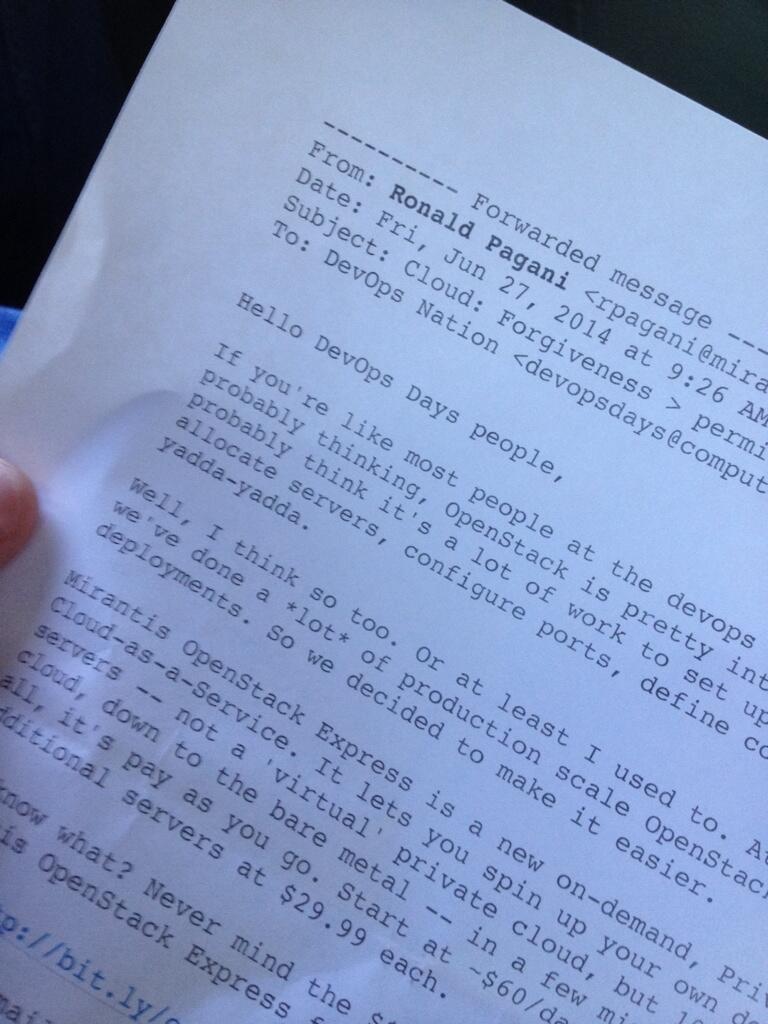 First, a public shaming. Some goober from Merantis left this spam on everyone’s car. Bah.
Presentations
@bridgetkromhout spoke on “how I learned to stop worrying and love devops” and @benzobot spoke on onboarding and mentoring apprentices. DoD SV certainly made a strong effort to get more female speakers this year! We tried in Austin (I personally wrote like every local techie woman group I could find) but we only had like one.
Then there were two super bad ass presentations back to back. I can’t find the slides online yet.
The Future of Configuration Management
Mark Burgess (@markburgess_osl), aka “The CFEngine Guy” and noted Promise Theory advocate, spoke. Chef and Puppet had eclipsed CFEngine for a while but it turns out as the Internet of Things and containers and stuff are arriving that maybe many of his design decisions were actually prescient and not retro. Here it is broken down into wise sayings.
- Why do we not have CAD for IT systems?
- Orchestration is not bricklaying.
- We need the equivalent of style sheets for servers.
- We are entering a world of decentralized smart infrastructure.
- Scale, complexity, and knowledge increase as our desire for flexibility increases.
- Separation of concerns adds complexity and fragility.
- To handle complexity – atomize and untether.
- 3D printed datacenters are coming.
DevOps as Relationship Management
James Urquhart (@jamesurquhart) spoke about the interconnectedness of our systems. The SEC, post flash crash, added circuit breakers, defined rollback protocols, inserted agents into the flow of the stock exchange trading systems to prevent uncontrolled cascading.
One simple rule – visualize the whole system (monitor your outside relationships) but take action at the agent level. “How are you doing today?” “Good.” Monitoring is going well, new approaches in the space look at policies and interactions and performance and business medtrics – but need to differentiate reductionist vs expansionist approaches.
Michal Nygard’s book Release It! is full of great patterns, and Netflix’ open sourced Hystrix is an example of the kind of relational system safeguards you can build off it.
Ignite Block
- Tips for Introverts (at Conventions) by Tom Duffield – They include find a role, don’t fear failure, attend preconference activities, go to lunch early and sit, engage, share interests, find a comfortable setting, take time to recharge. As someone initially introverted myself (no one believes that now) I like that this has actual tips to get past it; in some circles “introversion” has become the new “Asperger’s” as a blanket excuse for not wanting to bother to relate to people.
- Mike Place on scalable container management – Google kubernetes is an example. Don’t just provision your systems, you need to manage them too. Images came and went and came back now, but you also can’t ignore what’s onboard the image. It’s time to join image and config management.
This was really good and the world should listen. On the one hand, conducting CM operations on 1000 servers in parallel is contributing unnecessarily to the heat death of the universe. On the other hand, you need to build those images in a non-manual way in the first place! And too many systems worry about the configuration but not the runtime operation. Amen brother! - Finally (well, there were two more, but I didn’t care for them so took no notes), John Willis (@botchagalupe) did [Darwin to] Deming to DevOps, a burst-fire reading list of nondeterminism tracing from Darwin through various scientists to the Deming/TPS stuff through into the DevOps world with Gene Kim and Patrick Debois. It was pimp. Here it is when he gave it at another venue:
Conclusions
Here’s some big themes from the week.
- Deterministic, reductionist, and centralized are for suckers.
- Complexity is the enemy. Systems thinking is necessary.
- We love continuous deployment. But DevOps is not just about delivering code to production.
- Women exist in DevOps and are cool. More would be great.
- Most vendors have figured out to just relax and talk to techies in a way they might listen to. Some haven’t.
It was a great event, kudos to Marius and the other organizers who put in a lot of work to wrangle 500 people, nearly 30 sponsors, food, venue, and the like. If you haven’t been to a DevOpsDays, look around, there may be one near you! I help organize DevOpsDays Austin (just had our third annual) and there’s ones coming this year from Tel Aviv to Minneapolis.
If you went to DoD SV, feel free and comment below with your thoughts (linking any posts you’ve made, slides, etc. is welcome too)!
Filed under Conferences, DevOps
DevOpsDays Silicon Valley 2014 Day One Notes
I have more notes from Velocity, but thought I’d do DevOpsDays first while it’s freshest in my brain. This isn’t a complete report, it’s just my thoughts on the parts I felt moved to actually write down or gave me a notable thought. More notes when I was learning, less when I wasn’t (not a reflection on the quality of the talk, just some things I already knew a bit about).
DevOpsDays Silicon Valley 2014 was June 27-28 at the San Jose Computer Museum. 500 people registered; not sure how many showed but I’d guess definitely in excess of 400.
Day One
State of the Union
First we had John Willis (@botchagalupe) giving the DevOps State of the Union. Here’s the slides (I know it says Amsterdam, he gave it there too.) This consisted of two parts – the first was a review of Gene Kim et al’s 2014 State of DevOps Report – go download it if you haven’t read it, it’s great stuff.
The second part is about how we are moving towards software defined everything – robust API driven abstractions decoupled from the underlying infrastructure. John’s really into software defined networking right now as it’s one of the remaining strongholds of static-suckiness in most infrastructures. A shout out to the blog at networkstatic.net and tools like mesos and Google’s kubernetes that are making computing even more fluid (see this article for some basics). “Consumable, composable infrastructure.”
Saying No
Next, our favorite Kanban expert Dominica DeGrandis (@dominicad) spoke on “Why Don’t We Just Say No?” Here’s the slides. As a new product manager, and as a former engineering manager who had engineers that would just take on work till they burst even with me standing there yelling “No! Don’t do it!”, it’s an interesting topic.
Why do you take on more work than you have capacity to do? She cites The Book Of No by Susan Newman, Ph. D and a very recent Psychology Today “Caveman Logic” post called Why So Many People Just Can’t Say No. She proposes that it is easier for devs to say no; ops have more pressing demands and are forced into too much yes. Some devs took exception to this on twitter – “our product people make us do all kinds of stuff we don’t like to” – but I think that’s different from the main point here. It’s not that “you have to do something you don’t like and are overruled when you say no” but that “you become severely over-committed due to requests from many quarters and being unwilling to say no.”
She goes through a great case study of changing over a big ops shop to a more modern “SRE” model and handle both interrupt and project work by getting metrics, having a lower WIP limit, closing out >90 day old tickets, and saying no to non-emergency last minute requests. In fact, the latter is why I prefer scrum over kanban for operations so far – she contended that devs have an easier time saying no to interrupt work because of the sprint cadence. OK, so adopt a sprint cadence! Anyway, by having some clear definitions of done for workflow stages they managed to improve the state of things considerably. Use kaizen. The book about the Pixar story, Creativity Inc., talks about how the Pixar folks were running themselves ragged to try to finish Toy Story, till someone left their baby in a car because they were too frazzled. “Asking this much of people, even when they wanted to give it, was not acceptable.” What should your WIP level be? The level of “personal safety” would be a great start!
It’s interesting – I did some of these things at Bazaarvoice and tried to do some other ones too. But often times the resistance would be from the engineers that the current process was working to death. “We can’t close those old tickets! They have valuable info and analysis and it’s something that needs to happen!” “Yes, but our rate of work done and rate of work intake proves mathematically that they’ll never get done. Keeping them open is therefore us making a false promise to whoever logged those tickets.” Not everyone is able to ruthlessly apply logic to problems – you’d think that would be an engineer attribute but in my experience, not really any more than the general population. But given that “not acceptable” quote above, I really struggled with how to get engineers who were burning themselves out to quit it. It’s harder than you’d think.
Agile at Scale
Next was a fascinating case study from Capital One’s transformation to an agile, BDD, devops-driven environment given by Adam Auerbach (@bugman31). The slides are available on Slideshare. They used the Scaled Agile Framework (SAFe) and BDD/acceptance test driven development with cucumber as well as continuous integration. In a later openspace there were people from Amex, city/state/federal governments, etc. trying to do the same thing – Agile and DevOps aren’t just for the little startups any more! He reported that it really improved their quality. Hmm, from the Googles it looks like the consulting firm LitheSpeed was involved, I met one of their principals at Agile Austin and he really impressed me.
Sales and Marketing Too
Sarah Goff-DuPont (@devtoolsuperfan) spoke about having sales and marketing join the agile teams as well. Some tips included cross-pollinating metrics and joining forces on customer outreach.
Ignites
Just some quick thoughts from the day one Ignites.
- @eriksowa on OODA and front end ops and screaming at your team in German (I am in favor of it)
- Aater (futurechips) on data acquisition and multitenancy with docker
- Jason Walker on LegoOps
- Ho Ming Li on Introducing DevOps
- @seemaj from Enstratius on classic to continuous delivery – slides. Pretty meaty with lots of tool shout-outs – grunt, bowler, angular, yo, bootstrap, grails, chef, rundeck, hubot, etc. I don’t mind a good laundry list of things to go find out more about!
- Matt Ho on Docker+serf – with Docker there is a service lookup challenge. AWS tagging is a nice solution to that. Serf does that with docker like a peer-to-peer zookeeper. Then he used moustache to generate configs. This is worth looking at – I am a big fan of this approach (we did it ourselves at National Instruments years ago) and I frankly think it’s a crime that the rest of the industry hasn’t woken up to it yet.
Openspaces
If you haven’t done openspaces before, it’s where attendees pitch topics and the group self-organizes into a schedule around them. Here’s some pics of part of the resulting schedule:
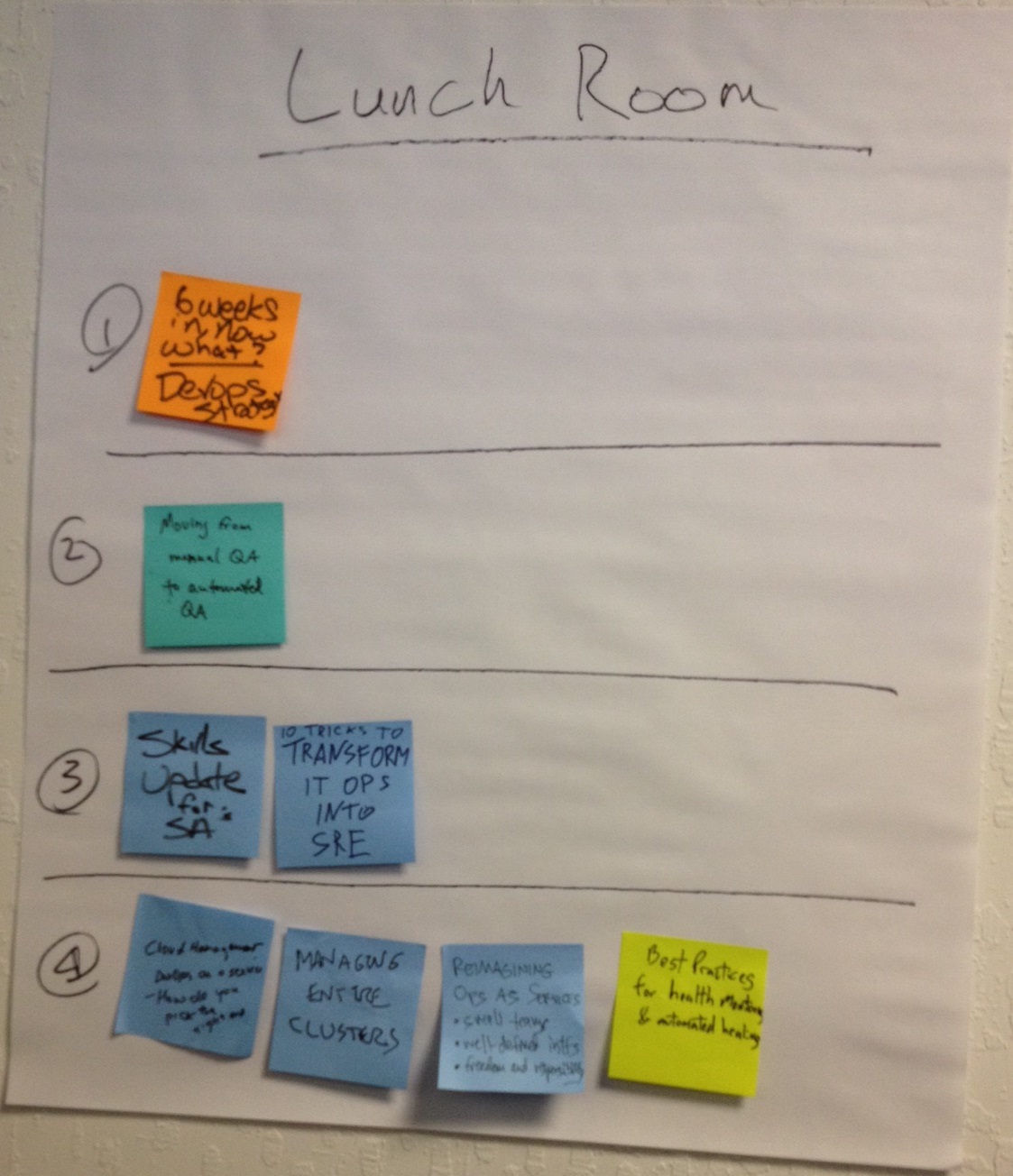
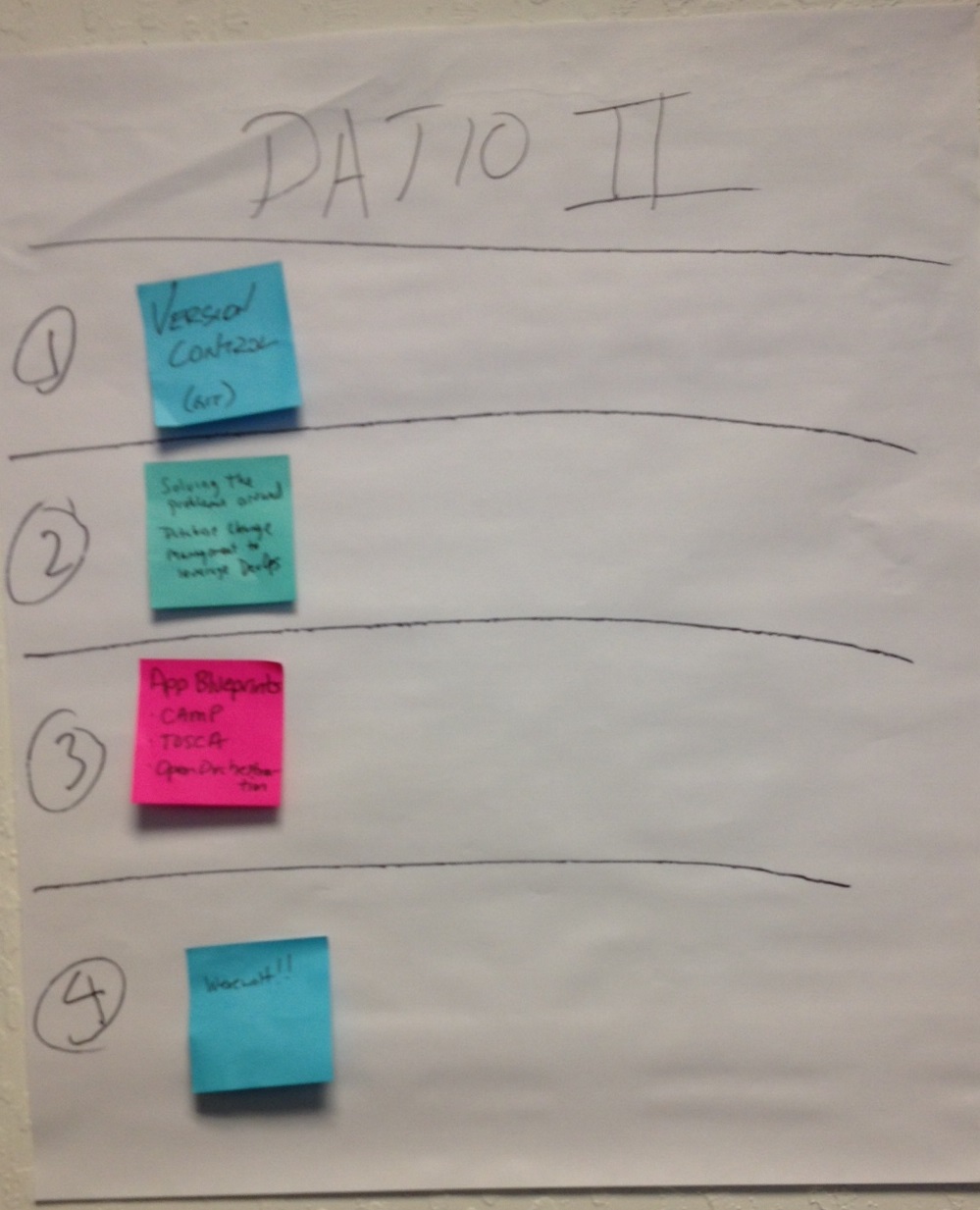

I went to two. The first was a combination of two openspace pitches, “Enterprise DevOps” and “ITIL, what should it be?” This was unfortunately a bad combination. Most folks wanted to talk about the former, and the Capital One guy was there and people from Amex etc. were starting to share with the group. But the ITIL question was mostly driven by a guy from the company that “bought ITIL” from the UK government and he had a bit of a vendory agenda to push. So most of the good discussion there happened between smaller groups after it broke up.
The second was a CI/CD pipeline one, and I got this great pic of what people consider to be “the new standard” pipeline.
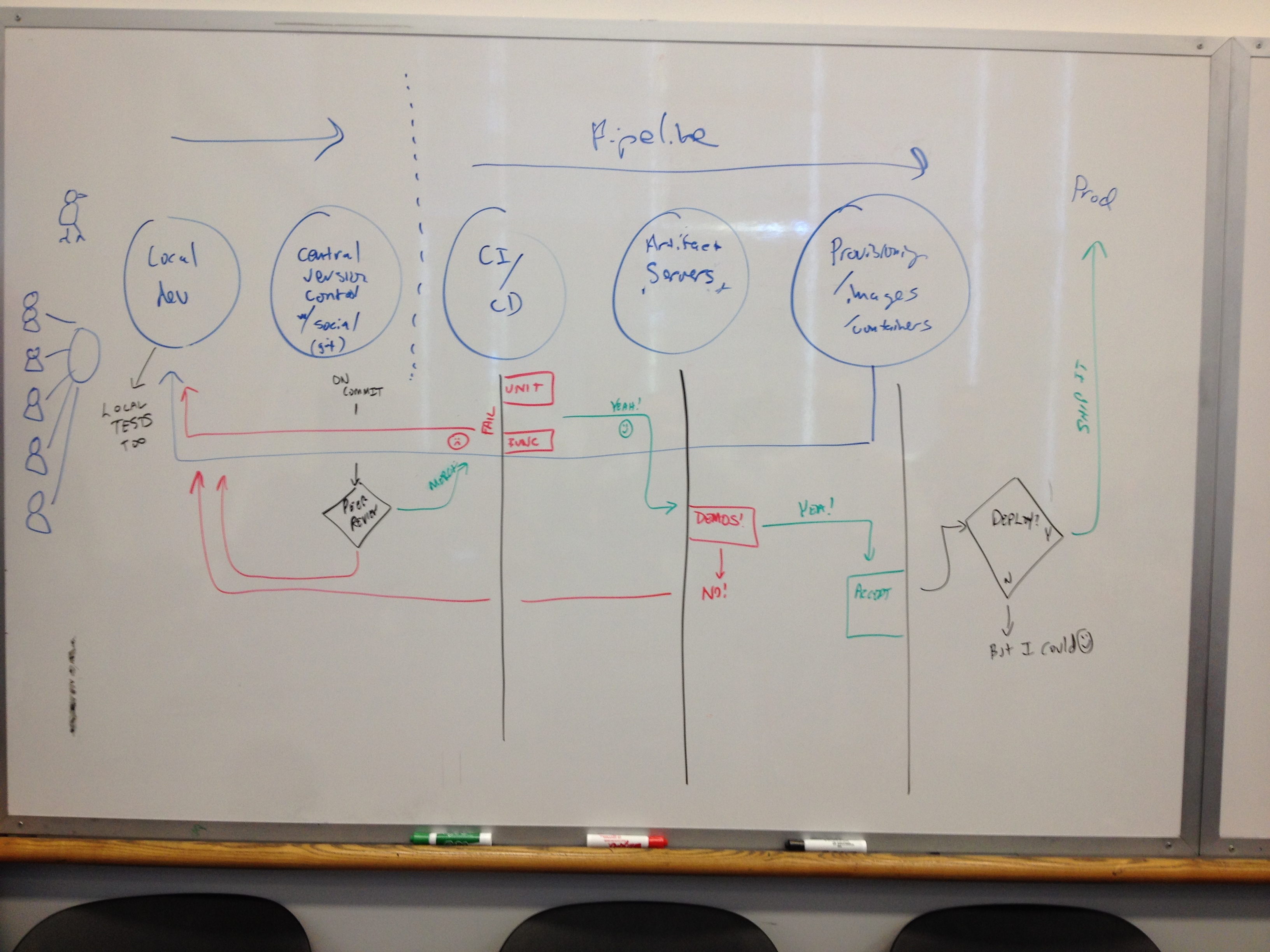
Generally Accepted Continuous Integration and Delivery Pipeline
Next, Day 2 and wrap-up!
Filed under Conferences, DevOps
Meet The Agile Admins At Velocity/DevOpsDays Silicon Valley!
Three of the four agile admins (James, Karthik, and myself) will be out at Velocity and DevOpsDays this week. Say hi if you see us!
James will be doing a workshop with Gareth Rushgrove on Tuesday 9-10:30 AM, “Battle-tested Code without the Battle – Security Testing and Continuous Integration.” Get hands on with gauntlt and other tools! [Conference site] [Lanyrd]
Ernest is doing a 5 minute sponsor keynote on Thursday, “A 5 Minute Checklist for Application Monitoring.” OK, so it’s during the USA vs Germany game – come see me anyway! I hate keynote sales pitches so I’m not doing one, I’ll be talking about a Lean approach to monitoring and stuff to cover in your MVP. There’s a free white paper too since what can you really say in 5 minutes? And so you know what to expect, the hashtag you’ll want to use is #getprobed! [Conference site] [Lanyrd]
Filed under Conferences
Monitoring and the State of DevOps
If you haven’t read the new 2014 State of DevOps Report from Puppet Labs and other luminaries, check it out now!
I also pulled out some of their findings on monitoring to inspire a post for the Copperegg blog, Monitoring and the State of DevOps, which I thought I’d mention here too.
Filed under DevOps, Monitoring
Filtering Your Datadog Event Stream
At both NI and Bazaarvoice I was a Datadog user; I wrote a piece for them on filtering the event stream that has just been published on the Datadog blog. Check it out!
Filed under DevOps
Agile Organization: Separate Teams By Discipline
This is the first in the series of deeper-dive articles that are part of Agile Organization Incorporating Various Disciplines. It’s very easy to keep reorganizing and trying different models without actually learning from the process. I’ve worked with all of these so am trying to condense the pros and cons to help people understand the implications of the type of organizational model they choose.
The Separate Team By Discipline Model
Separate teams striated by discipline is the traditional method of organizing technical teams – segmented horizontally by technical skill. You have one or more development teams, one or more operations teams, one or more QA teams. In larger shops you have even more horizontal subdivisions – like in an enterprise IT shop, under the banner of Infrastructure you might have a data center team, a UNIX admin team, a SAN team, a Windows admin team, a networking team, a DBA team, a telecom team, applications administration team(s), and so on. It’s more unusual to have the dev side specifically segmented horizontally by tech as well (“Java programmers,” “COBOL programmers,” “Javascript programmers”) but not unheard of; it is more commonly seen as “UX team, services team, backend team…”
 In this setup in its purest form, each team takes on tasks for a given product or project inside their team, works on them, and either returns them to the requester or passes them through to yet another team. Team members are not dedicated to that product or effort in any way except inasmuch as the hours they spend working on the to-do(s). Usually this is manifested as a waterfall approach, as a product or feature is conceived, handed to developers to develop, handed to QA to test, and finally handed to Operations to deploy and maintain.
This model dates back to the mainframe days, where it works pretty well – you’re not innovating on the infrastructure side, the building’s been built, you’re moving your apps into the pre-built apartment units. It also works OK when you have heavy regulation requirements or are constrained to extensively documenting requirements, then design, etc. (government contracts, for example).
It works a lot less well when you need to move quickly or need any kind of change or innovation from the other teams to achieve your goal. Linking up prioritization across teams is always hard but that’s the least of the issues. Teams all have their own goals, their own cadences, and even their own cultures and languages. The oft-repeated warning that “devs are motivated to make changes and ops is motivated by system stability” is a trivial example of this mismatch of goals. If the shared teams are supporting a limited number of products it can work. When there are competing priorities, I’ve seen it be extremely painful. I worked in a shop where the multiple separate dev teams were vertical (line of business organized) but the operations teams were horizontal (technical specialty organized) – and frankly, the results of trying to produce results with the impedance mismatch generated by that setup was the nightmare that sent me down the Agile and DevOps path initially.
Benefits of Disciplinary Teams
The primary benefit of this approach is that you tend to get stable teams of like individuals, which allows them to bond with those of similar skills and experience organizational stability and esprit de corps. Providing this sense of comfort ends up being the key challenge of the other organizational approaches.
The second benefit is that it provides a good degree of standardization across products – if one ops team is creating the infrastructure for various applications, then there will be some efficiencies there. This is almost always at least partially, and sometimes more than entirely, counteracted in value by the fact that not all apps need the same thing and that centralized teams bottleneck delivery and reduce velocity. I remember the UNIX team that would only provide my Web team expensive servers, even though we were highly horizontally scaled and told them we’d rather have twice as many $3500 servers instead of half as many $7000 servers as it would serve uptime, performance, etc. much better. But progress on our product was offered up upon the altar of nominal cost savings from homogeneity.
The third benefit is that if the horizontal teams are correctly cross-trained, it is easier avoid having single points of failure; by collecting the workers skilled in something into one group, losses are more easily picked up by others in the group. I have to say though, that this benefit is often more honored in the breach in my experience – teams tend to naturally divide up until there’s one expert on each thing and managers who actively maintain a portfolio and drive crosstraining are sadly rare.
Drawbacks of Disciplinary Teams
Conway’s Law is usually invoked to worry about vertical divisions in a product – one part of the UI written by one team, another by another, such that it looks like a Frankenstein’s monster of a product to the end user. However, the principle applies to horizontal divisions as well – these produce more of a Human Centipede, with the issue of one phase becoming the input of the next. The front end may not show any clear sign of division, but the seams in quality, reliability, and agility of the system can grow like a cancer underneath, which users certainly discover over time.
This approach promotes a host of bad behaviors. Pushing work to other people is always tempting, as is taking shortcuts if the results of those shortcuts fall on another’s shoulders. With no end to end ownership of a product, you get finger pointing and no one taking responsibility for driving the excellence of the service – and without an overall system thinking perspective, attempts at one of the teams in that value chain to drive an improvement in their domain often has unintended effects on the other teams in that chain that may or may not result in overall improvement. If engineers don’t eat their own dog food, but pass it on to someone else, then chronic quality problems often result. I personally spent years trying to build process and/or relationships to try to mitigate the dev->QA->ops passing of issues downstream with only mixed success.
Another way of stating this is that shared services teams always provide a route to the tragedy of the commons. Competing demands from multiple customers and the need for “nonfunctional” requirements (performance, availability, etc.) could potentially be all reconciled in priority via a strong product organization – but in my experience this is uncommon; product orgs tend to not care about prioritization of back end concerns and are more feature driven. Most product orgs I have dealt with have been more or less resistant to taking on platform teams, managing nonfunctional requirements, and otherwise interacting with that half of demands on the product. Without consistent prioritization, shared teams then become the focus of a lot of lobbying by all their internal customers trying to get resource. These teams are frequently understaffed and thus a bottleneck to overall velocity.
Ironically, in some cases this can be beneficial – technically, focusing on cost efficiency over delivering new value is always a losing game, but some organizations are self-unaware enough that they have teams continuing to churn out “stuff” without real ROI associated (our team exists therefore we must make more), in which case a bottleneck is actually helpful.
Mitigations for the weaknesses of this approach (abdication of responsibility and bottlenecking constraints) include:
- Very strong process guidance. “If only every process interface is 100% defined, then this will work”, the theory goes, just as it works on a manufacturing line. Most software creation, however, is not similar to piecing components together to make an iPod. In one shop we worked for years on making a system development process that was up to this task, but it was an elusive goal. This is how, for example, Microsoft makes the various Office products look the same in partial defiance of Conway’s Law – books and books of standards.
- Individuals on shared teams with functional team affinities. Though not going as far as embedding into a product team, you can have people in the shared teams who are the designated reps for various client teams. Again, this works better when there is a few-to-one instead of a many-to-one relationship. I had an ops team try this, but it was a many-to-one environment and each individual engineer ended up with three different ownership areas, which was overwhelming. In addition, you have to be careful not to simply dedicate all of one sort of work to one person, as you then create many single points of failure.
- Org variation: Add additional crossfunctional teams that try to bridge the gap. At one place I worked, the organization had accepted that trying to have the systems needs of their Web site fulfilled by six separate infrastructure teams was not working well, so they created a “Web systems” team designed to sit astride those, take primary responsibility, and then broker needs to the other infrastructure teams. This was an improvement, and led to the addition of a parallel team responsible for internal apps, but never really got to the level of being highly effective. In addition those were extremely high-stress roles, as they bore responsibility but not control of all the results.
Conclusion
Though this is the most typical organization of technology teams historically, that history comes from a place much different than many situations we find ourselves in today. The rapid collaboration approach that Agile has brought us, and the additional understanding that Lean has given us in the software space, tells us that though this approach has its merits it is much overused and other approaches may be more effective, especially for product development.
Next, we’ll look at embedded crossfunctional service teams!
DevOps Updated
Since I had some time and have been thinking about it lately, I’ve upgraded and expanded my definition of DevOps on theagileadmin. Healthy debate welcome!
March 20, 2014 · 3:48 pm
 the agile admin