
Here’s my LASCON 2016 presentation on Lean Security, explaining how and why to apply Lean Software principles to information security!
Category Archives: Conferences
November 4, 2016 · 9:04 am
Three Upcoming DevOps Events You Should Attend
I wanted to mention a couple Austin area events folks should be aware of – and one international one! November is full of DevOps goodness, so come to some or all of these…
The international one is called All Day DevOps, Tuesday November 15 2016, and is a one long day, AMER and EMEA hours, 3-track, free online conference. It has all the heavy hitter presenters you’d expect from going to Velocity or a DevOpsDays or whatnot, but streaming free to all. Sign up and figure out what you want to watch in what slot now! James, Karthik, and I are curating and hosting the Infrastructure track so, you know, err on that side 🙂 There’s nearly 5000 people signed up already, so it should be lively!
Then there’s CD Summit Austin 2016. There’s a regional IT conference called Innotech, and devops.com came up with the great idea of running a DevOps event alongside it. It’s Wednesday November 16 (workshops) and Thursday November 17 (conference) in the Austin Convention Center. All four of the Agile Admins will be doing a panel on “The Evolution of Agility” at 11:20 on Thursday so come on out! It’s cheap, even both days together are like $179.
But before all that – the best little application security convention in Texas (or frankly anywhere for my money) – LASCON is next week! Tues and Wed Nov 1-2 are workshop days and then Thu-Fri Nov 3-4 are the conference days. I’m doing my Lean Security talk I did at RSA last fall on Friday, and James is speaking on Serverless on Thursday. $299 for the two conference days.
Loads of great stuff for all this month!
Filed under Conferences, DevOps
Links on Bridging Security and DevOps
If you remember, I (@wickett) said I would be doing more blogging for Signal Sciences in the new year. We still are in January, but I am glad to say that so far so good. Here are a couple highlights from recent posts:
-
What security experts need to know about DevOps and continuous delivery < This post made it on DevOps Weekly (which of course you should subscribe to) which is awesome! The article takes a few topics and breaks them down for what they mean to InfoSec. Unfortunately to many security people, devops is still Ops 2.0 and is mainly about chef/puppet or that systemic madness called Continuous Delivery. This article attempts to show how security can fit in the new world of devops.
-
Security Visibility: If You Can’t See ’Em, You Won’t Stop ‘Em! by @txs breaks down the three questions that should keep you up at night if you care about security. This article lays the groundwork of bridging devops and security by focusing on three pragmatic questions. This is a must read.
- Rugged Software Engineering video with Nick Galbreath at GOTO London is a recording of Nick’s excellent talk at GOTO London. The GOTO London videos just got uploaded a few weeks back so they are fresh off the presses and ready for your viewing pleasure. I think this talk along with Dan North’s talk on the history of Agile were the highlights of the conference. I will be adding in more links and talks from the conference over the coming weeks and even the one yours truly did.
That’s all for now. Happy Friday everyone!
Filed under Conferences, DevOps, Security
DevOps Enterprise Summit Videos Are Up
There’s a crop of great talks from this event, check them out here. If you look really hard you can see my talk too!
Filed under Conferences, DevOps
Innotech Austin Continuous Delivery Summit
Last week we had a DevOps track branded “CD Summit” at Innotech Austin, run by devops.com, and the agile admins were there!
I did a presentation about the various DevOps transformations I had a leadership role in at National Instruments and Bazaarvoice:
And James Wickett did a presentation on Application Security Epistemology in a Continuous Delivery World:
Jez Humble also spoke, as well as a batch of other folks including Austinite Boyd Hemphill and “our friend from Chicago” JP Morgenthal. Once those slides are all posted I’ll pass the link on to you all!
Filed under Conferences, DevOps
ShirtOps: How to Make T-shirts for Tech Conferences that People Actually Wear
Over the last 6 years I have helped organize over 10 different conferences (all the LASCON conferences, all the DevOpsDays Austin conferences, AppSec USA 2012, and even a couple for my church) and for most of the events I have been in charge of swag. T-shirts, bags, shot glasses, lanyards, usb keys… You name it, I have swagged it.
From all these conferences I have learned a few things, and specifically I have learned a bit about making t-shirts. T-shirts are a funny thing. Everyone has opinions, however as an organizer you have to learn that most of those opinions are wrong. I have had lots of bad ideas recommended to me by well-meaning organizers and friends: Print the logo big! Put all the sponsors logos on the back (also known as the “the NASCAR special”). Have a big design on the back which I like to call “the restaurant shirt.” Then there is the design someone on the team knocked out with MS Paint.
Everyone has good intentions, but as the one in charge of making the shirt you have to lead them through the process. Show the team what good actually means. In this presentation I highlight the last several years of DevOpsDays Austin t-shirts and walk you through the process of how to make t-shirts people want to wear after the event is over.
Links from the presentation:
If you have any other tips, add to the comments and/or tweet with #shirtops.
Filed under Conferences, DevOps
DevOps 101 at Innotech San Antonio
Here’s a DevOps 101 presentation based on the definition of DevOps here at The Agile Admin I’m delivering at Innotech San Antonio tomorrow as part of a devops.com attempt to spread DevOps learning to IT and the enterprise. (You probably want to go view it on slideshare.com so you can read the notes, too…)
Filed under Conferences, DevOps
AWS re:Invent Keynote Day 2 Takeaways
TL;DR – performance improvements and two huge announcements, Docker-based EC2 Container Service and cloud-CEP-like AWS Lambda.
I was in a meeting for the first 45 minutes but I hear I didn’t miss much. Happy customer use cases.
The first big theme of this morning’s keynote is “Containers” – often just shorthand for “docker.” I went to a previous event here in town with even large enterprises and government – State of Texas, Microsoft, Dell, Red Hat – all freaking out about Docker. Docker is similar to VMWare or cloud in that it is a new technology that requires new monitoring and management just for it. (Heck, Eric, the CopperEgg founder, is now running a startup around docker container management, StackEngine.)
- Keynote from pristine.io about how they implemented. Docker, the new low overhead containerization technology, is a heavily cited part of the power (they actually used Flux7 as the expert consultants, they’re based here in Austin!).
- Keynote from Werner Vogels on the new “Amazon EC2 Container Service,” announced to cheers and applause. It allows launching and terminating containers to sets of instances on EC2. Their PM did a demo where they had a big farm of r3 servers and then they deploy a redis cluster and rabbitmq across them, and then front end components on a farm of c3s, and then audio processing across all of them. If you’re new to this it’s basically VMs within VMs but without noticeable overhead.
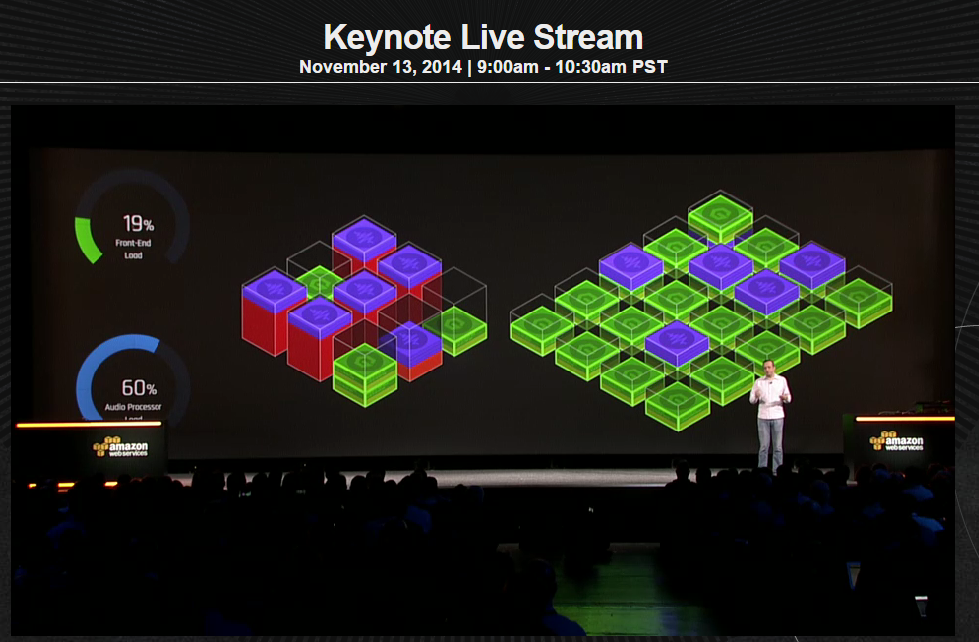
EC2 Container Service
- Next they had the actual docker cofounder and CEO Ben Golub. He mentioned that docker is only 18 months old and its huge success and ecosystem this early in is “surreal.”
Next… Leapfrogging PaaS?
- Werner is back to announce AWS Lambda available now in preview – event-driven computing service for dynamic applications. No instance running/management required, events go in and “cloud functions” run on them. Holy shit, this replaces a large number of servers running semi-trivial apps. 20 cents per million requests, plus some complex stuff for seconds of execution – free for 3.2M seconds/1M requests.
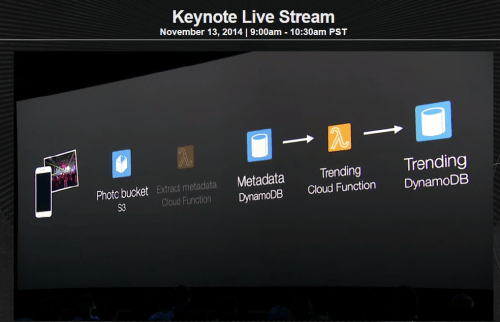
Amazon Lambda
- Netflix chief product guy came on to show how they’re using lambda as a higher level abstraction and have eliminated a bunch of servers – no system monitoring/management, no inefficient polling, no gaps/opacity. They’re using it to encode video, run backups, run security and compliance checks against instances, and for operational monitoring and dashboards. Replacing procedural control systems with event-driven services.
- AWS core innovations… New c4 instance, Haswell based (crazy fast processor, 36 vCPUs). Diane Bryant, SVP/GM Data Center Group from Intel, came on to go into the CPU specifically. Larger and faster EBS volumes, up to 20,000 IOPS. Enhanced and consistent networking speeds.
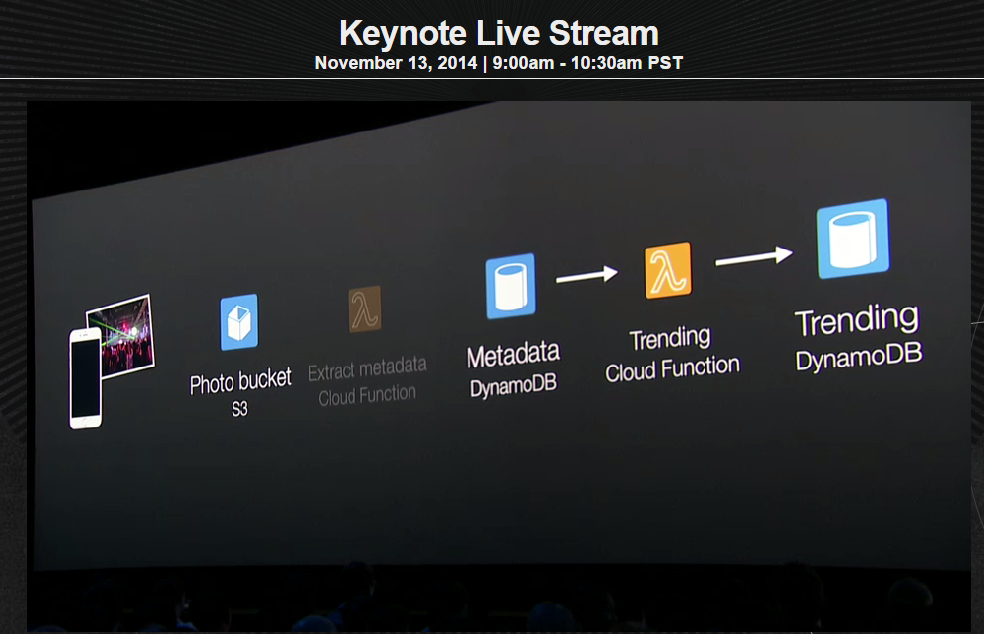
And this has been your cloud update! Also see Ben Kepes in Forbes for a similar summary.
The container engine is cool – it’ll certainly remove a lot of instance gerrymandering and instance reservation pain if nothing else. But Lambda is the potential disruptor here. It’s taking the idea of “bring your own algorithm” from MapReduce and saying “hmmm you can probably replace your trivial web app just with this” – it’s halfway between a PaaS and a SaaS, none of the Beanstalk complexity, just “here take this function and run it on stuff when it comes in.” If a library of common lambas becomes available, so much computing work done for trivial purposes becomes obsoleted. Who hasn’t seen a Web service to “upload a file here, then zip it or something, then store it…” OK, no servers needed any more. Very interesting.
Filed under Cloud, Conferences
AWS re:Invent Keynote Day 1 Takeaways
Sadly I couldn’t attend this year, but heck that’s what the Internet is for. Here’s the interesting bits from the AWS re:Invent Day 1 keynote (livestreamed here). Loads of interesting stuff.
- AWS is growing revenue >40% YOY, far outstripping other large IT companies – EC2 use grew 99% YOY and S3 usage 137%, they have 1M active customers now. (Microsoft cloud services report 128% YOY growth as well.)
- New product announcement for Aurora – new commercial-grade database engine – fully MySQL compatible but 5x the performance, available through Amazon RDS, 1/10 the cost of the commercial DB engines (starts at 29 cents an hour, ~$210/mo). Can do 6M inserts/second and 30M selects/second. Highly durable (11 9’s), crash recovery in seconds with no data loss. Nice!
- SLDC stuff!
- CodeDeploy (was internal tool called Apollo), a new code-deployment system that lets you do rolling updates, rollbacks, and tracks deployment health. This works for all languages and is free. They use it internally for 95 deploys/hour on their own stuff.
- In early 2015 will come some more software lifecycle management services – first is CodePipeline for continuous integration and deployment (also used internally)
- Second is CodeCommit as a managed code repository that can colocate with where you’re going to deploy and has no size limits of repos or files. These “integrate with” github, jenkins, chef, etc. though it’s not clear how they don’t cannibalize them.
- Security stuff! Big push to be able to say “we easily surpass the security you can do on premise.”
- FISMA, ITAR, FIPS, FedRAMP, HIPAA, ISO 9001
- Current encryption approach is either “let Amazon manage keys” or use their CloudHSM hosted key thing, both of which are still a pain. As a result they’re launching AWS Key Management Service as a HA service that manages keys, provides one-click encryption and transparent key rotation.
- AWS Config is a new-gen agile CMDB with full visibility into all your AWS resources. You can query it and see relationships and show scope of a config change. Streams all config changes out to you.
- A new-gen service catalog called AWS Service Catalog available early 2015. Create and share product portfolios, let internal people launch them, tracking and compliance.
- Enterprise Cloud Adoption Patterns
- Often the first wave of moving into the cloud for enterprises is moving dev and test environments to run in AWS for flexibility and spin up/down for cost savings and brand new apps, custom written for the cloud
- Second wave is web sites and digital transformation (media, corp sites, ecomm) and analytics, since mass processing and sharing is cheap in the cloud – data warehouses (like pfizer’s). And mobile app back ends – phone, tablet, gps, more.
- Third wave is business critical applications. Macmillan and Hoya run their SAP in AWS. Conde Nast runs HR and Legal there.
- New wave – you’re starting to see entire datacenter migration and consolidation as DCs come up for lease (Hess, Conde Nast, NewsCorp). SunCorp. Time Inc., GPT, Nippon Express moving “all in” to AWS – many ISVs as well. The CIA moved to AWS and now Intuit is doing so now as well.
- Intuit moved their “TurboTax AnswerXchange” app there to deal with tax time peaks last year and the scales fell from their eyes when they did so – 6x cost cut, setup 1/5 of the time, faster development. They started doing more and realized the global datacenters, ease of integration with acquisitions, and dev recruiting benefits. They have 33 services on AWS now, and have moved mint.com there. They have decided to move everything else there now. Funny how once companies start looking at how much they accomplish instead of just the monthly cost the “cloud is more expensive at scale” argument gets dropped like a flaming bag of poo.
- Hybrid cloud
- Various stuff like directory service (AD in the cloud) and identity federation and storage gateway and SystemCenter and vCenter integration already exist to power mixed shops
- Johnson & Johnson went on for a while about their use of AWS. They are planning a 25,000 seat deployment of Workspaces (virtual desktop offering, like Citrix).
Whew, that’s the quick notes version. Aurora is obviously of interest – a lot of the fretting over whether to use mySQL or RDS I’ve seen will get settled by this – it was just ‘well, run the same thing yourself or have them do it…” and now it’s “have them run something insanely better”. But the SDLC tools are also interesting – they made noise about how these “work with!” ansible, jenkins, git, etc. but that seems mildly disingenuous, without any more looking into it yet they sound more like direct competition for them. But the config and service catalog could be great extensions – yay for simple composable services, not huge painful “BSM/ITMOM suites”.
Feel free and share your thoughts on the announcements in the comments section!
Filed under Cloud, Conferences
Velocity 2014 After Action Report
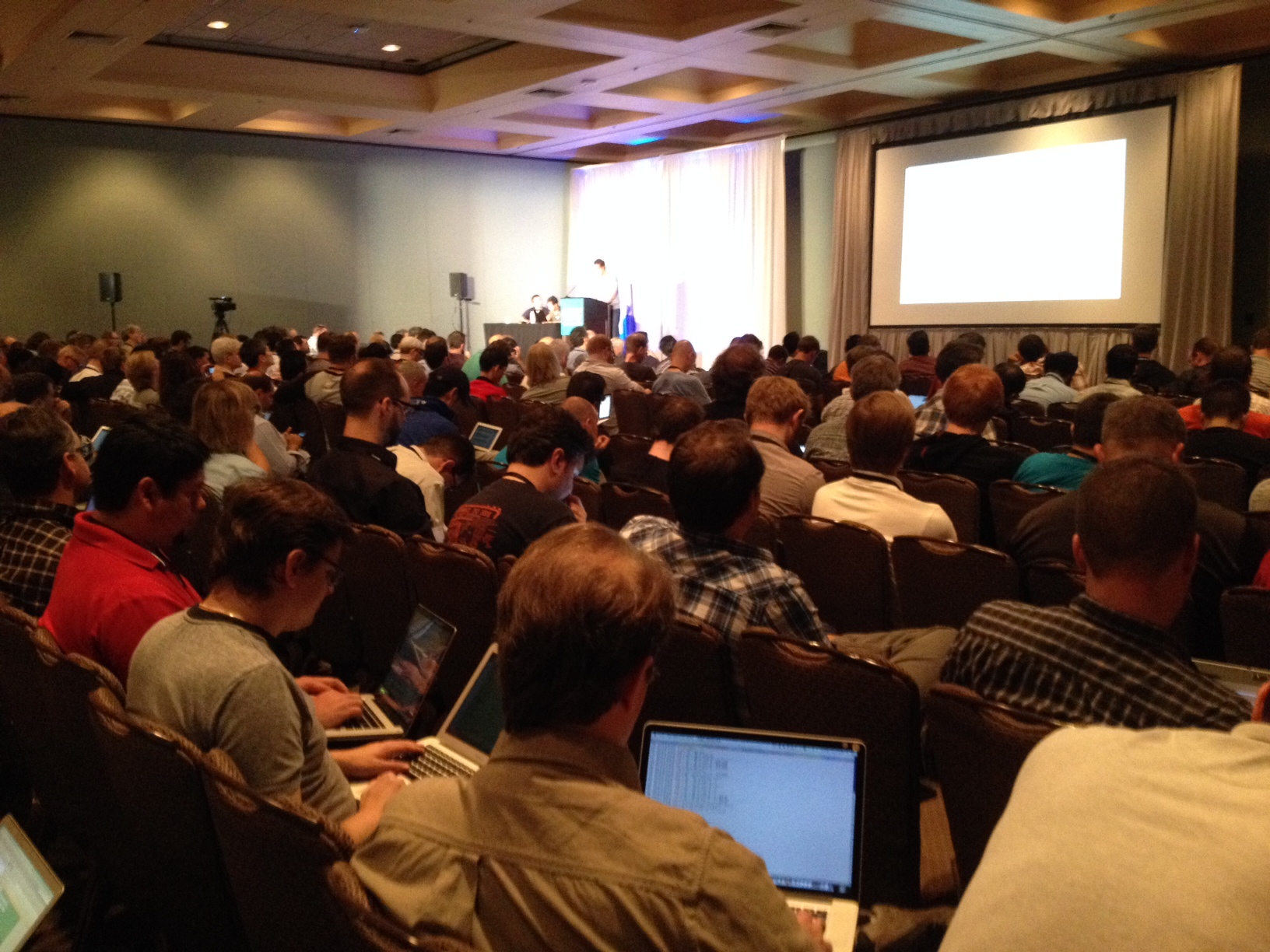
An Average Velocity Session
Well, it was my first Velocity (I’ve been to every one, 2008 to present, you can read the previous reports here on the blog) as a vendor! So that was different, and I split time between working the Copperegg booth and going to sessions. As a result I’m not going to do the extensive session-by-session notes I’ve done in the past. Two other Agile Admins, James and Karthik were there, I’m hoping they do some writeups of sessions they attended too!
Being a vendor was interesting; though standing at the booth made my dogs bark after the day was over, it was great to be able to talk to so many people. There were a lot of monitoring providers at the show (Copperegg (us), Compuware, New Relic, Datadog, many more). Pingdom was right across from us, with a slate of guys shipped in from Sweden, but they were generally grumpy – jet lag or their recent acquisition, perhaps. A new log management SaaS provider was there, logentries.com, and that was interesting – Sumo is the only real one in the space since Loggly and SplunkStorm borked it up and they’ve been getting a little… “Enterprise-y?” By that I mean having sales reps call you 5x/day and wanting near-Splunk prices. So yay to the newcomers, competition is always good. Other than that, it was mostly the same slate of Velocity-vendors as usual.
What’s New
Well, let’s get it out of the way – there wasn’t all that much new this year. Karthik complained to me that “last year, Velocity was my favorite conference ever, and this year I didn’t get much out of it.” Not every year hosts a bunch of new techniques, sadly, but I thought there were some gems in there. Here’s the major four new trends taking up speech-space:
Docker docker docker containers containers containers. Learn it now because in a year everything will be in containers – no, seriously. Largest splash in computing since Amazon AWS. The hype is a little overexcited at times but there’s a lot of new development going on here. On the one hand, not everyone needs new-box spinup in 5s instead of 5m and the efficiency gains are a tradeoff for security – but to be blunt, people stopped well short of exercising the elasticity and ephemerality of cloud/virtualization solutions, instead going for the more comfortable “let’s deploy a three tier app manually like we did back in the day, but in the cloud” and so containers will be a disruption to push forward the concept of dynamic service orchestration etc., which is good.
There is starting to be buzz around Internet of Things. Mark Burgess (CFEngine, author of “In Search Of Certainty”) did a presentation on IoT and a more distributed model of monitoring and computation. Worth looking at, and it’s becoming more a part of mainstream computing (“engineering” tech and “IT” tech split off from each other 15 years ago for whatever reason and are just now joining forces again). Since we Agile Admins all had worked at National Instruments and had tried to get them onto the IoT bandwagon like 5 years ago, we grumped among each other about this.
There’s also strong interest in software defined networking (OpenDaylight, Cumulus). John Willis (@botchagalupe) waxed poetic on the topic and it fit into the general push towards making everything programmable.
There was strong and sustained interest (presentations, etc.) on STEM education and specifically on women in tech/getting more women into tech.
Keynotes

My Room At The Avatar
Video of these should be publicly available so you can watch them.
Jeff Dean of Google did a very interesting talk on making large scale services low latency that I recommend everyone view (video is at the link). Shared environments increase utilization but also congestion, exacerbated by large fanout systems – if a given system has services with only 1% 1 sec latency and have you to touch 100 services to finish your call, 63% of calls take more than a second. Traditional latency reduction uses techniques like differentiated service classes, breaking up large requests, managing background activity (rate limit, wait till low load). Tolerating faults is a lot like tolerating variability – extra resources make your system reliable – do the same with variability, but much lower timeframe. There’s two ways to do that…
- Cross Request Adaptation – examine recent behavior and make changes (load balance, scale) – low timescale, this tends to make the “next call” faster. Fine grained dynamic partitioning relies on equal sizes and constant load, but if you break up into 10-100 things a machine you can shed load more effectively. Selective replication, like in query system they make more copies of important docs. Use latency-induced probation via your load balancer, offload to other boxes, shadow stream to original, return to service when it’s better.
- Within Request Adaptation – make the call faster within the single call! Basically this is a series of refinements on “send the request two places.” First he modeled sending the request again to another server if it didn’t return in an expected amount of time. You can get cuter, like by always sending to two destinations and having the one that starts working on it give a sideways “I’ve got it” to the other. His mathematical analysis says that you can cut latency dramatically for a very small increase in load, and not only that, but the response of a loaded cluster and an idle cluster become very similar (less dramatic spiking under load).
And I did one! Just a 5 minute spot since Copperegg was a platinum sponsor; I talked about applying a Lean approach to implementing monitoring. It was called A 5 Minute Checklist For Application Monitoring and slides/video are at the link. I also wrote a white paper to expand on it that’s available for download here.
Sessions
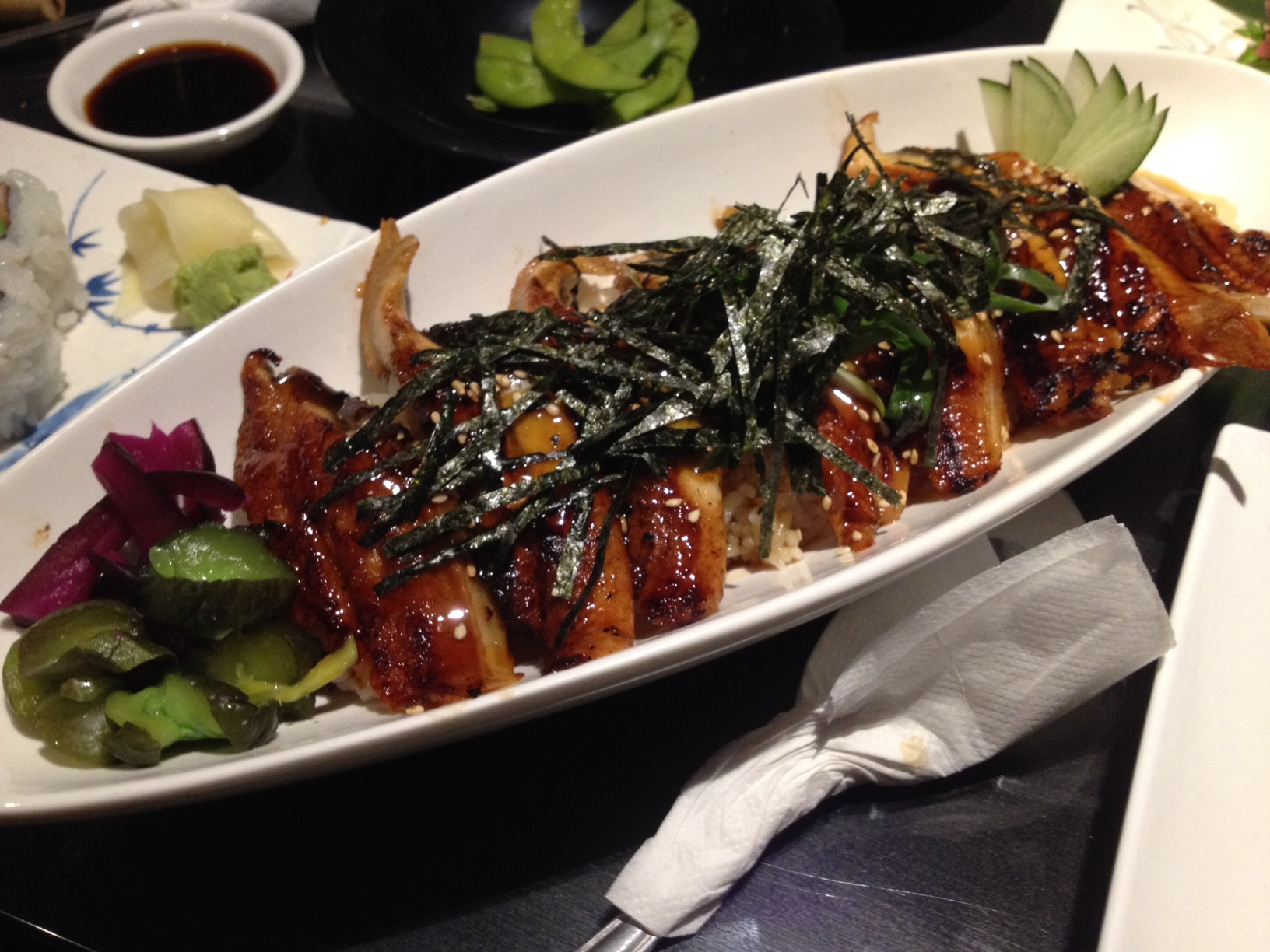
California Sushi
I went to a number of sessions that I enjoyed; here’s a quick breakdown of the ones I thought were winners. I’ll try to find slides and link them where they exist. O’Reilly charges for the videos though.
Vladimir Vuskan’s workshop on ganglia. People like the gathering of mass metrics. They did rake him over the coals a bit on the 15s time resolution and the relatively primitive RRDTool graphs. He had some interesting bits like a “check that a value is the same everywhere” alert for consistency. He also summed up “why we monitor” well – MTTD, MTTR, trending, learning.
Theo Schlossnagle’s presentation on Understanding Slowness. He recommended a system map as step 1 – high level box and line but low level with all versions, locations, and service connections. He also talked about going to histograms but less sophisticated users find those hard to understand, so displaying quantiles can be a happy medium. He sees three different tool spaces: observational, synthetic, and manipulation.
There was a good presentation by Dan Slimmon (video of same talk from Monitorama)on the math around false alarms, using the “sensitivity” and “specificity” terms from medicine. Here’s a quick reference on those and how you calculate a positive predictive value. Undetected outages are embarrassing so the response is to narrow the monitoring thresholds but this just generates more false alerts, aka “pagerrhea.” This segued into the discussion of using better means to detect deviation – hysteresis, moving thresholds like Holt-Winters, cross-correlation of metrics, Fourier transforms. You should alert on whether work is getting done, not on CPU or swap but on HTTP response time and requests per second. He wants “something like nagios but that separates detection from diagnosis.”
I also really appreciated the LinkedIn talk on technical debt. They admitted that several years ago, they were trying to keep up in the social world and just ground to a halt because of accumulated technical debt. They had to stop and take a bunch of time to fix it before they could move forward. Important takeaways included:
- Technical debt comes small decision by small decision
- Don’t wait for version n+1, fix it now
- “One in a million” problems happen a lot at web scale
- Cancerous workarounds are no good
- Broken window syndrome – if things are broken, people will tend to leave things broken
- Zombie tech will eat you
- Use our cool rest.li REST framework!
- Employee engagement drains KPIs
- Strategies – recognize debt choices and decisions
- Use new eyes – consultants, interns – to identify the “bad parts”
- Measure the right things
- Technical debt you can see is only the tip of the iceberg
- Make active decisions otherwise in Soviet Russia, Decision Makes You! (well, I added that last part)
The last really good one was about confirmation bias and monitoring. When dealing with metrics there are a lot of cognitive illusions – the anchoring effect (whatever it was recently before it deviated must have been right), the validity effect (a couple people told me that so it must be true), illusory correlation (looks like those happened around the same time), attitude polarization (round up the usual suspects). The way to combat this is with analysis. Rethink your data flow, validate your stats. Use anomaly detection like the open sourced skyline and oculus to really detect correlations and deviations.
Though there weren’t as many breakthroughs this year, I appreciated the incremental uptick in wisdom about how to use what we have!
Social
Much of the benefit of conferences isn’t the sessions, it’s the great people you meet and share experiences with. Once you’ve been a couple years, you get to see old friends – though sadly none of our compatriots from Agile Admin alumni companies were there (National Instruments, Bazaarvoice, PowerReviews) we did get to see most of the “usual suspects” we get to see at these shows – we had the usual “hang out at the Hyatt bar fiesta” with Andrew Schafer, John Willis, Ben Rockwood, Cameron Haight and Jonah Kowall from Gartner, Gene Kim, and many more. Notable in his absence was Patrick Debois who remained in Belgium, we all missed him.
If you went to Velocity this year, chime in below (especially if we met you there!).
Filed under Conferences, DevOps
 the agile admin