Author Archives: Ernest Mueller

Ernest Mueller's avatar

About Ernest Mueller

Ernest is the VP of Engineering at the cloud and DevOps consulting firm Nextira in Austin, TX. More...

Steal This Teambuilder: Meat, Guns, and Booze

I thought I’d take a minute for a teambuilding tip from Management Corner and share a winning teambuilder from here in Austin that I’ve used a lot and has always been a solid success. We call it “Meat, Guns, and Booze.” Steal it and use it with your teams!

Coming up with good teambuilders for an engineering team is pretty difficult.  You have a mix of introverts and extroverts. Going to a movie doesn’t really allow for much personal interaction.  A group meal lets you talk to the 3-4 people next to you, which in large groups isn’t a large percentage, and even getting everyone seated together can be a challenge.  Not everyone drinks and may not appreciate hanging out at a bar. Messing around in the office is fine but sometimes you want to get out of there so that people aren’t continually distracted by work. Not everyone is active enough for something like paintball (especially in Texas weather!). Well, back some years ago while I was at National Instruments we were mulling over what a good field trip/teambuilder could be given all these limitations, and happened across a winning combination that never fails to deliver!

Meat
BBQ At Smitty's 4

Meat Frenzy

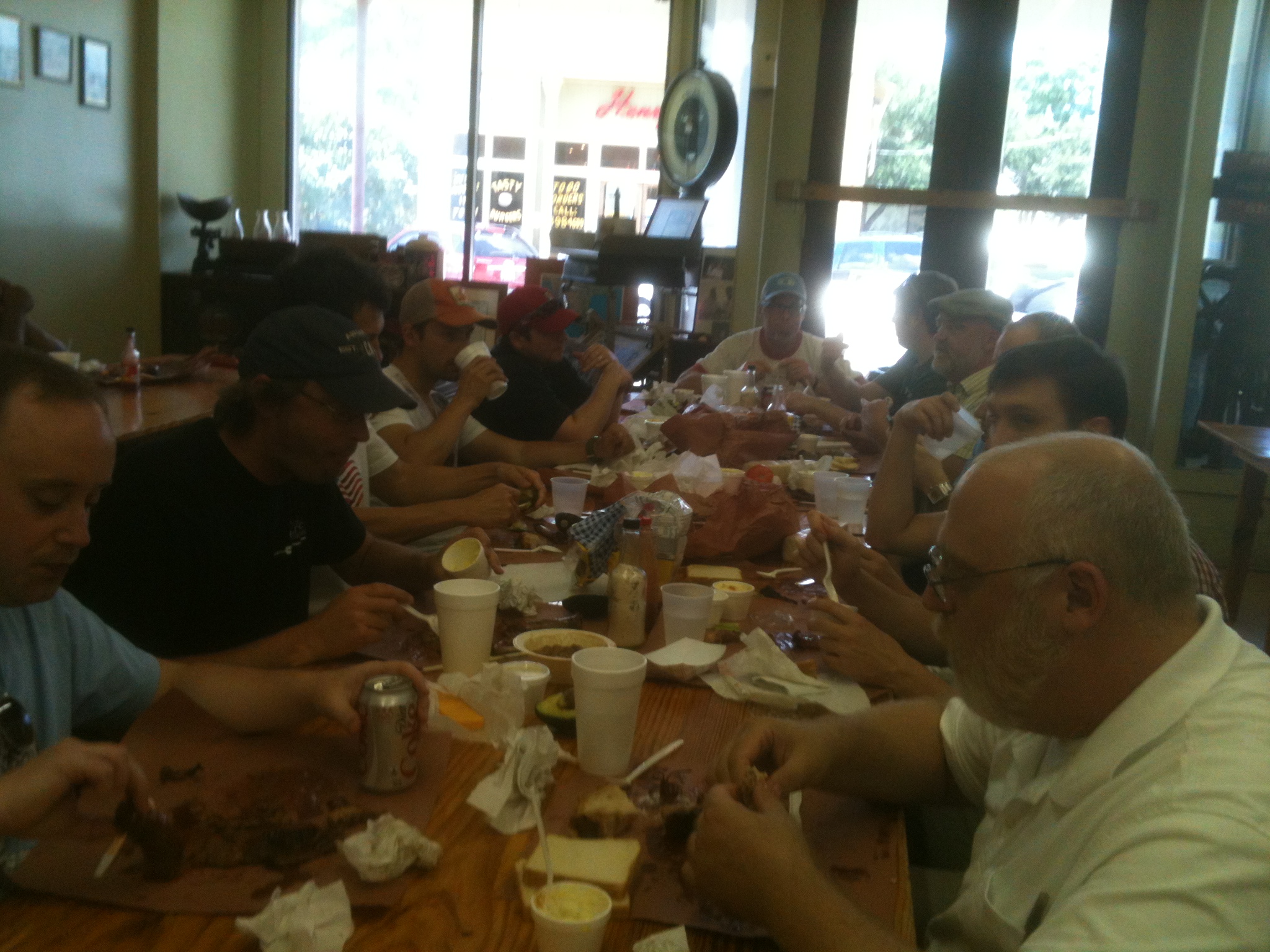
First, head out to Lockhart, about an hour from most places in Austin, for a lunch of barbeque. Austin BBQ is good, but for the truly top tier stuff you have to go out to other locations (we love Franklin’s/LA Barbecue but going and standing in line at 10 AM to get some isn’t really a team activity). You can have internal debates over whether you go to Black’s, Smitty’s, or Kreutz’; try them all out over time as everyone will passionately defend the one they think is best. For vegetarians, there’s good sides, but also there’s a cafe right across the street from Smitty’s Market with salads and whatnot. Smitty’s also has a “no utensils” rule; eating meat with your hands definitely switches the mood to informal and friendly quickly!

Pro Tip: Bring cash. Some of them – Smitty’s for sure IIRC – don’t take credit!

Blacks BBQ

Goodsprings from Fallout: New Vegas?

Besides the great BBQ, many folks haven’t seen old style rural Texas – even folks living in Austin, but especially people from other countries. I remember once we were headed into town, and it has a traditional town square with raised boardwalks and all – and the two guys from Ukraine in the back seat started wriggling around like itchy bear cubs and talking rapidly to each other in Ukranian.  “What’s up?” I asked from the driver’s seat.  “It looks just like Fallout!” they breathlessly exclaimed. I had to laugh. It’s worth a brief stroll around the town square and courthouse. There’s a western-stuff store for the greenhorns, too.

Guns

IMG_0781

My .30/.30

IMG_0775

A Ukranian Engineer Learns About Texas

If it’s raining, you can fall back to Red’s in Austin, they have several locations.  But they’re small and cramped for groups. Right near Lockhart is the Lone Star Gun Range. They have rifle and pistol ranges, outdoor but with shade.  You just need a driver’s license (or passport for the foreigners) and you can rent anything from a revolver to an AK-47 for a reasonable fee – you mainly end up paying for ammunition. (You can bring your own guns and ammo, but have to buy their ammo to use in their rental guns.) They give a quick safety briefing and off you go.  As long as you have one or two more gun-savvy people to help folks who are having trouble figuring out how to reload or whatnot, you’re good to go; I’ve been there many times with groups of 10-20 composed of mostly noobs with no problems. And don’t worry – everyone gets into it.  I’ve had people who were initially intimidated but once they get hands on for a minute they always take to it with gusto.

Even in Texas, gun owners usually don’t go out to the range all the time, so it’s a treat even for those who are more into it, and a novelty for those who aren’t.

Pro Tip: Don’t drive a super-nice car – the road to the place is not paved, it’s shell.  If you have a sweet hand-waxed Porsche you should ask someone else to drive. Also, it’s outside in Texas in (whatever season) – bring sunscreen, hats, and a cooler full of water. There is an air-conditioned store with a bathroom and all if someone gets overwhelmed by the heat.

Steve on the Barrett 1

The Barrett

Sad Note: They used to have a Barrett .50 out there at Lone Star but they sold it.  The rounds were super expensive but no one wanted to fire more than 1 or 2 anyway! But they have revolvers, automatics, rifles from .22 to ARs to AKs…

Booze

After shooting, you’re usually hot, and so stopping in at a watering hole on your way back to Austin is a good thing to do.  Anywhere that’s convenient for you is good – I’ve done the Whip In as that’s uber Austiny, has an outdoor patio with picnic tables for good social mobility, and has a lot besides just beer (food, wide non-alcoholic drink variety). You got out of the office (and out of town), had the team nourish itself on food, then have an exciting activity, and now they get to interact with the ice already well broken. People don’t drink a lot because it’s already been a long day, as opposed to a “let’s go drink” teambuilder where people are more tempted to overindulge. But they have plenty to talk about. Non-drinkers – or if your entire company doesn’t like sponsoring events with alcohol – can just drink sodas and have an appetizer or two to unwind.

And yes, to all the wags out there who inevitably respond with “but don’t mix up the order!”, you do want to do it in this order – there’s the wisdom of no drinking before gun handling, but also because this sequence of events is carefully constructed to provide a cadence of icebreaking and interaction. You “break bread” together, which is a universal signal of togetherness, and sit by some people to eat, by others in the car, interact with others while doing a stimulating activity, unwind with others after, etc. And since it’s multipart, if someone really does have to come late or leave early there are multiple natural breakpoints. We also like doing three-round K1 racing as teambuilders but that’s more disruptive if people come and go.

I’ve used this teambuilder with multiple teams, multiple companies, and it’s always a hit. It’s especially a hit with international teams – folks from Malaysia, Ukraine, etc. see all of this as a special treat; it’s very common to talk to them a year later about their trip to Austin and they’ll immediately volunteer that this was their favorite part of their visit hands down. It’s relatively inexpensive and just takes a long afternoon (we usually leave at 11 and start wrapping up at 5). It’s maybe $1000 for a full day of fun for a dozen people.

Not In Austin?

Well of course the luridly titled “Meat, Guns, and Booze” specifically evokes Texas and is tuned to our location.  But consider the same kind of event cadence and think about what’s distinctive in your area. You just want the team to share a meal, then participate in an activity that everyone can easily participate in, and then have an opportunity to relax and talk with each other afterwards.


4 Comments

Filed under General

Agile Organization Incorporating Various Disciplines

I started thinking about this recently because there was an Agile Austin QA SIG meeting that I sadly couldn’t attend entitled “How does a QA manager fit into an Agile organization?” which wondered about how to fit members of other disciplines (in this case QA) in with agile teams. Over the last couple years I’ve tried this, and seen it tried, in several ways with DevOps, QA, Product Management, and other disciplines, and I thought I’d elaborate on the pros and cons of some of these approaches.

Two Fundamental Discoveries

There are two things I’ve learned from this process that are pretty universal in terms of their truth.

1. Conway’s Law is true. To summarize, it states that a product will tend to reflect the structure of the organization that produces it. The corollary is that if your organization has divisions which are of no practical value to the product’s consumer, you will be creating striations within your product that impact client satisfaction. Hence basic ITSM and Agile doctrines on creating teams around owning a service/product.

2. People want to form teams and stay with them. This should be obvious from basic psychology/sociology, but if you set up an organization that is too flexible it strongly degrades the morale of your workers. In my previous role we conducted frequent engineer satisfaction surveys and the most prominent truth drawn from them is the more frequently people are asked to change roles, reorg, move to different teams, the less happy they are. Even people that want to move around to new challenges frequently are happier if they are moving to those new challenges with a team they’ve had an opportunity to move through Tuckman’s stages of group development with.

I have seen enough real-world quantified proof of both of these assertions that I will treat them as assumptions going forward.

Organizational Options

We tried out all four of these models within the same organization of high performing engineers and thus had a great opportunity to compare their results.

Separate Teams

When we started, we had the traditional model of separate teams which would hand off work to each other.  “Dev,” “Ops,” “QA,” “Product” were all under separate management up through several levels and operated as independent teams; individual affinities with specific products were emergent and simply matters of convenience (e.g. “Oh, he knows a lot about that BI stuff, let him handle that request”) and not a matter of being dedicated to specific product(s).

Embedded Crossfunctional Service Teams

Our first step away from the pure separate team model was to take those separate teams and embed specific members from them into service oriented teams, while still having them report to a manager or director representing their discipline. In some cases, the disciplinary teams would reserve some number of staff for tool development or other cross-cutting concerns. So QA, for example, had several engineers assigned to each product team, even though they were regarded as part of the permanent QA org primarily.

We (very loosely) considered our approach to be decentralized and microservice based; Martin Fowler is doing a good article in installments on Microservice Architecture if you want more on that topic.

Fully Integrated Service Teams

With our operations staff we went one step farther and simply permanently assigned them to product teams and removed the separate layer of management entirely. Dev and “DevOps” engineers reported to the same engineering manager and were a permanent part of a given product team. Any common tooling needed was created by a separate “platform” engineering team which was similarly integrated.

Project Based Organization

Due to the need to surge effort at times, we also had some organizations that were project, not product, based. Engineers would be pulled either from existing teams or entire teams would additionally be pulled into a short term (1, 2, 3 month) effort to try to make significant headway across multiple products, and then dissolve afterwards.

Hmm, this looks like it’s getting big (and I need to do some diagrams).  I’ll break it up into separate articles for each type of org and its pros and cons, and then a conclusion.

12 Comments

Filed under Agile, DevOps

Special CloudAustin SXSW Edition 3/6

There’s a special early CloudAustin user group this month on Thursday, March 6 out at Rackspace. We’re having some folks from  West Coast startup Stormpath (http://stormpath.com/), API-driven user and group management for developers come and give two talks:

Cloud Marketing 101: How to Market Your Cloud Product

You pour blood, sweat and tears into your API, open source and weekend projects – let’s make sure they get the attention they deserve! We’ll go through real-world examples of tactics developers can do to attract attention to their work. Beyond growth hacking and that first post to Hacker News, we’ll look at high-value marketing maneuvers that will drive usage, but won’t make you feel like a dirty huckster.

To Infinity and Beyond! Scaling Your Stack with Service Oriented Architecture

Abstract: Service Oriented Architecture is a proven design pattern which allows you to simplify your codebase, seamlessly scale your service, reduce engineering frustrations — and even helps lessen hosting costs. Come learn what SOA is, why it’s useful, and take a look at an in-depth technical overview of SOA, and how it can help your organization. Delight your engineers (and business people!) by building your product on top of simple, REST API services.

Sign up here! http://www.meetup.com/CloudAustin/events/161089112/

Leave a comment

Filed under Cloud, Conferences

Evolution of Bazaarvoice’s Architecture to 500M Unique Users Per Month

Check out this article by @victortrac on High Scalability on how we have scaled our infrastructure at Bazaarvoice to be serving out a billion product reviews a day!

Leave a comment

by | December 2, 2013 · 3:07 pm

A DevOps Thanksgiving

This last week at the Agile Austin DevOps SIG, our topic was simple – “A DevOps Thanksgiving.” We all shared what we’re thankful for from the DevOps world this year – things that have made our lives better.

It was a nice and refreshing discussion!  People mentioned the things making their lives better. Group members expressed their thanks for such diverse things as DevOps Weekly, rspec-puppet, The Phoenix Project, Vagrant, Docker, test-kitchen with serverspec and bats, provisioned IOPS in AWS, DevOps Cafe, The Ship Show, increasing crossplatform support in DevOps tools and thinking, DevOps tracks springing up at conferences like Agile 2013 and AppSec, DevOpsDays… Thanks to all the people who put in lots of their hard work to make them all possible!

In retrospect we have a lot to be thankful for.  Even though the techno-hipsters don’t even want to say the word “DevOps” any more, it’s a very real change bringing better things to our tools, products, and even lives. I know I’ve seen a lot of change in the teams I’ve worked with that have implemented it – fewer “all hands overnight releases,” less psychotic oncall, less inter-group hatefulness – DevOps has brought us all a lot of good things, and it’s just starting to take hold out there in the industry.

How about you?  What DevOps thing were you thankful for this year?  Add into the comments here, blog it up yourself, tweet it (I suggest #devopsthanksgiving as the hashtag)…  Spread the thanks!

Leave a comment

Filed under DevOps

LASCON Interview: Jason Chan

 IMG_1513Jason Chan (@chanjbs) is an Engineering Director of the Cloud Security team at Netflix.

Tell me about your current gig!

I work on the Cloud Security team at Netflix, we’re responsible for the security of the streaming service at Netflix.  We work with some other teams on platform and mobile security.

What are the biggest threats/challenges you face there?

Protecting the personal data of our members of course.  Also we have content we want to protect – on the client side via DRM, but mainly the pipeline of how we receive the content from our studio partners. Also, due to the size of the infrastructure, its integrity – we don’t want to be a botnet or have things injected to our content that can our clients.

How does your team’s approach differ from other security teams out there?

We embody the corporate culture more, perhaps, than other security teams do. Our culture is a big differentiator between us and different companies.  So it’s very important that people we hire match the culture. Some folks are more comfortable with strong processes and policies with black and white decisions, but here we can’t just say now, we have to help the business get things done safely.

You build a security team and you have certain expertise on it.  It’s up to the company how you use that expertise. They don’t necessarily know where all the risk is, so we have to provide objective guidance and then mutually come to the right decision of what to do in a given situation.

Tell us about how you foster your focus on creating tools over process mandates?

We start with recruiting, to understand that policy and process isn’t the solution.  Adrian [Cockroft] says process is usually organizational scar tissue. By doing it with tools and automation makes it more objective and less threatening to people. Turning things into metrics makes it less of an argument. There’s a weird dynamic in the culture that’s a form of peer pressure, where everyone’s trying to do the right thing and no one wants to be the one to negatively impact that.  As a result people are willing to say “Yes we will” – like, you can opt out of Chaos Monkey, but people don’t because they don’t want to be “that guy.”

We’re starting to look at availability in a much  more refined way.  It’s not just “how long were you down.”  We’re establishing metrics over real impact – how many streams did we miss?  How many start clicks went unfulfilled.  We can then assign rough values to each operation (it’s not perfect, but based on shared understanding) and then we can establish real impact and make tradeoffs. (It’s more story point-ish instead of hard ROI). But you can get what you need to do now vs what can wait.

Your work  – how much is reactive versus roadmapped tool development?

It’s probably 50/50 on our team.  We have some big work going on now that’s complex and has been roadmapped for a while.  We need to have bandwidth as things pop up though, so we can’t commit everyone 100%. We have a roadmap we’ve committed to that we need to build, and we keep some resource free so that we can use our agile board to manage it. I try to build the culture of “let’s solve a problem once,” and share knowledge, so when it recurs we can handle it faster/better.  I feel like we can be pretty responsive with the agile model, our two week sprints and quarterly planning give us flexibility. We get more cross-training too, when we do the mid-sprint statuses and sprint meetings. We use our JIRA board to manage our work and it’s been very successful for us.

What’s it like working at Netflix?

It’s great, I love it.  It’s different because you’re given freedom to do the right thing, use your expertise, and be responsible for your decisions. Each individual engineer gets to have a lot of impact on a pretty large company.  You get to work on challenging problems and work with good colleagues.

How do you conduct collaboration within your team and with other teams?

Inside the team, we instituted once a week or every other week “deep dives” lunch and learn presentation of what you’re working on for other team members. Cross-team collaboration is a challenge; we have so many tools internally no one knows what they all are!

You are blazing trails with your approach – where do you think the rest of the security field is going?

I don’t know if our approach will catch on, but I’ve spent a lot of my last year recruiting, and I see that the professionalization of the industry in general is improving.  It’s being taught in school, there’s greater awareness of it. It’s going to be seen as less black magic, “I must be a hacker in my basement first” kind of job.

Development skills are mandatory for security here, and I see a move away from pure operators to people with CS degrees and developers and an acceleration in innovation. We’ve filed three patents on the things we’ve built. Security isn’t’ a solved problem and there’s a lot left to be done!

We’re working right now on a distributed scanning system that’s very AWS friendly, code named Monterey. We hope to be open sourcing it next year.  How do you inventory and assess an environment that’s always changing? It’s a very asynchronous problem. We thought about it for a while and we’re very happy with the result – it’s really not much code, once you think the problem through properly your solution can be elegant.

1 Comment

Filed under Cloud, Conferences, Security

LASCON Interview: Nick Galbreath

IMG_1509Nick Galbreath (@ngalbreath) is VP of Engineering with client9, LLC.

What are you doing nowadays since leaving Etsy?

I am managing a small DevOps team for a company whose engineering team is based in Moscow, from Tokyo, Japan. Some other executives and our biggest customer is from there. And, I love Japan!

I know you from Velocity and the other DevOps conferences. Why are you here at a security conference?

I’ve been active at Black Hat, DEFCON, etc. as well as DevOps conferences. I’ve found that if your company is in operational chaos you don’t need security.  Once you have a good operational component and it’s not in chaos – standardized infrastructure, automation – you get up to the level where you can be effective at security.  I used the same approach at Etsy – I started there working on security, stopped, worked in infrastructure until that was basically squared away, and only then started working on security again. You have to work your way up Maslow’s hierarchy.

It’s the same with development. My background is originally development and when you’re programming in C/C++ your main effort is stability, but all those NPEs and other bugs are also security issues.  I don’t know any company doing well at security and not well at development, I’m not sure you can do it. Nail the basics and then the advanced topics are achievable.

What’s your opinion on how much the security space has left developers behind?

Look at the real core issues behind security. Dev teams have trouble with writing secure code, ops folks have problems with patching – at security conferences you don’t see anything for solving those problems.  Working on offense/breaking and blocking tools is lucrative but inhibits us from going after the root causes.

For many security pros, working in a team instead of solo is a different skill set. “We don’t want to bother the developers with this” – siloed approaches are killing us.

What do you see as the most interesting thing going on in the security landscape right now?

What has happened in the last 3-4 months, as much as I hate to say it, with all the leaking of documents – we’ve been lazy about encryption and privacy and other foundational elements and we assumed it worked, now we’re doing some healthy review to do a next generation of those. It brought that discussion to the forefront. The certificate authority problems, and the NSA stuff – we need to spend some time and think about this.  The next generation of SSL and certificate transparency are very interesting.

In terms of pure language work… Improvement of cryptography. Also, we’re making more business level APIs for common problems like PHP5’d password hashing APIs.  If your’e building a Web app and need auth you’re starting from zero most of the time and now you’re starting to see things put into the languages that solve these problems.

Out in the larger DevOpsey world, what are the things to watch, what is your team excited about?

Stuff that we’re excited about is traditional devops stuff like really treating our infrastructure like code.  No button clicking, infrastructure completely specified in config files in source control, code reviews, and then the file pushed to production to allocate/deallocate hardware and deploy software.  That’s a big change.

How do we disseminate best practices/prevent worst practices through those who aren’t the technical “1%?”

Well, best practices are harder

People went into server programming because they don’t like doing user interface stuff. But the joke’s on us, there is still a user interface, it’s configuration files, installers, etc. which are nontrivial. We should either be bundling audit software or server-side config healthchecks to provide warnings. “Why do you have SSL v2 enabled?” “Why are your .htaccess files visible by default?” [Ed: Where the hell did apache chkconfig go?]

People in ops can write these but retroactively folks won’t use them… But the future can have them.  If you at least get warned that your Apache config is using suboptimal security configs it’s your deliberate negligence to not do it right.

Maybe take the module approach (Apache wouldn’t want it in their core I’m sure) – if you want to work on it give me a call!

What message do you want to send to other security folks?

For security people, the message is, “It’s really important you start bringing your  non-security friends to these security conferences.” Devs and ops and business and QA. They’ll find it interesting and get involved. It’s really important.

Last year, we had a dozen people from my company come out to AppSec. But except for me and our security team, they’re not back this year. There just wasn’t enough content to hold the interest of the devs. What can we do about that?

Really!  Interesting.  Maybe we need more of a proper dev track, with more things like Karthik’s talk.

A project I’ve wanted to do for a very long time – most people in business and development don’t have  real idea of how much damage can be done, it’s why we have Red Teams. If someone’s really good at SQLi, etc. do a talk showing how much damage can be done.

Also – if you work at any company, you depend on an immense set of open source software and they don’t have a security person or anything.  Get involved in their process, try to help them and make it better and it’ll improve quality of everyone’s systems. We could do a hackathon during the convention to improve some existing projects.

Leave a comment

Filed under Conferences, DevOps, Security

LASCON 2013 Report – Second Afternoon

I’m afraid I only got to one session in the afternoon, but I have some good interviews coming your way in exchange!

User Authentication For Winners!

I didn’t get to attend but I know that Karthik’s talk on writing a user auth system was good, here are the slides. When we were at NI he had to write the login/password/reset system for our product and we were aghast that there was no project out there to use, you just had to roll your own in an area where there are so many lurking security flaws.  He talks about his journey and you should read it!

AWS CloudHSM And Why It Can Revolutionize Cloud

Oleg Gryb (@oleggryb), security architect at Intuit, and Todd Cignettei, Sr. Product Manager with AWS Security.

Oleg says: There are commonly held concerns about cloud security – key management, legal liability, data sovereignty and access, unknown security policies and processes…

CloudHSM makes objects in partitions not accessible by the cloud provider. It provides multiple layers of security.

[Ed. What is HSM?  I didn’t know and he didn’t say.  Here’s what Wikipedia says.]

Luckily, Todd gets up and tells us about the HSM, or Hardware Security Module. It’s a purpose built appliance designed to protect key material and perform secure cryptographic operations. The SafeNet Luna SA HSM has different roles – appliance administrator, security officer. It’s all super certified and if tampered with blows up the keys.

AWS is providing dedicated access to SafeNet Luna SA HSM appliances. They are physically in AWS datacenters and in your VPC. You control the keys; they manage the hardware but they can’t see your goodies. And you do your crypto operations there. Here’s the AWS page on CloudHSM.

They are already integrated with various software and APIs like Java JCA/JCE.

It’s being used to encrypt digital content, DRM, securing financial transactions (root of trust for PKI), db encryption, digital signatures for real estate transactions, mobile payments.

Back to Oleg. With the HSM, there’s some manual steps you need to do, Initialize the HSM, configure a server and generate server side certs, generate a client cert on each client, scp the public portion to the server to register it.

Normal client cert generation requires an IP, which in the cloud is lame. You can isntead use a generic client name and use the same one on all systems.

You put their LunaProvider,jar in your Java CLASSPATH and add the provider to java/security and you’re good to go.

Making a Luna HA array is very important of course. If you get two you can group them up.

Suggested architecture – they ahve to run in a VPC. “You want to put on Internet? Is crazy idea! Never!”

Crypto doesn’t solve your problem, it just moves it to another place. How do you get the secrets onto your instances? When your instance starts, you don’t want those creds in S3 or the AMI…

So at instance bootstrap, send a request to a server in an internal DC with IP, instance ID, public and local hostanmes, reservation ID, instance type… Validate using the API including instance start time, validate role, etc. and then pass it back. Check for dupes.  This isn’t perfect but what are ya gonna do?  You can assign a policy to a role and have an instance profile it uses.

He has written a Python tool to help automate this, you can get it at http://sf.net/p/lunamech.

1 Comment

Filed under Conferences, Security

LASCON 2013 Report – Second Morning

Everyone shuffles in slowly on the second morning of the con. I spent the pre-keynote hour with other attendees sitting around looking tired and comparing notes on gout symptoms.  (PSA: if the ball of your foot starts hurting really bad one day, it’s gout, take a handful of Advil and go to your doctor immediately.)

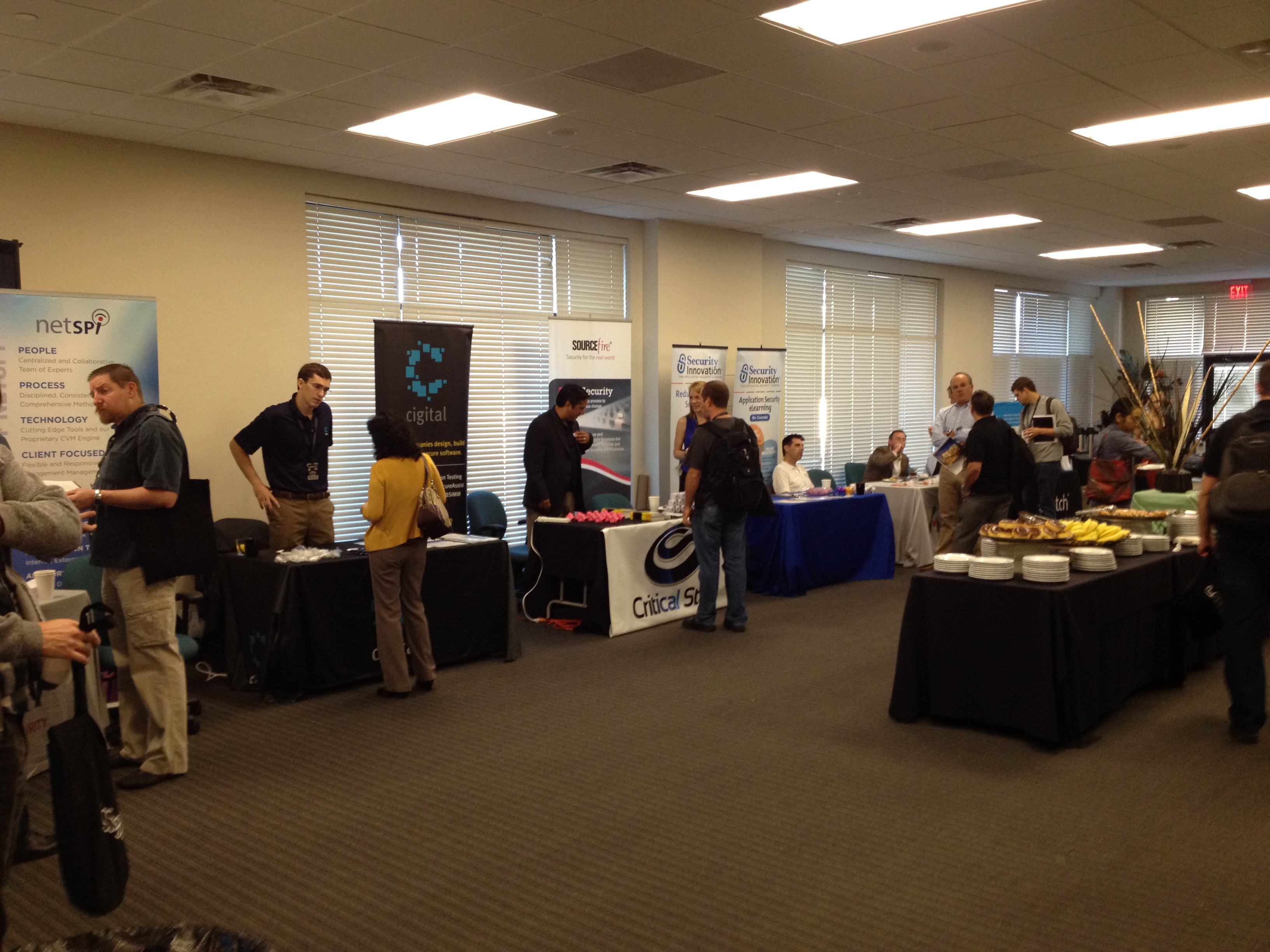
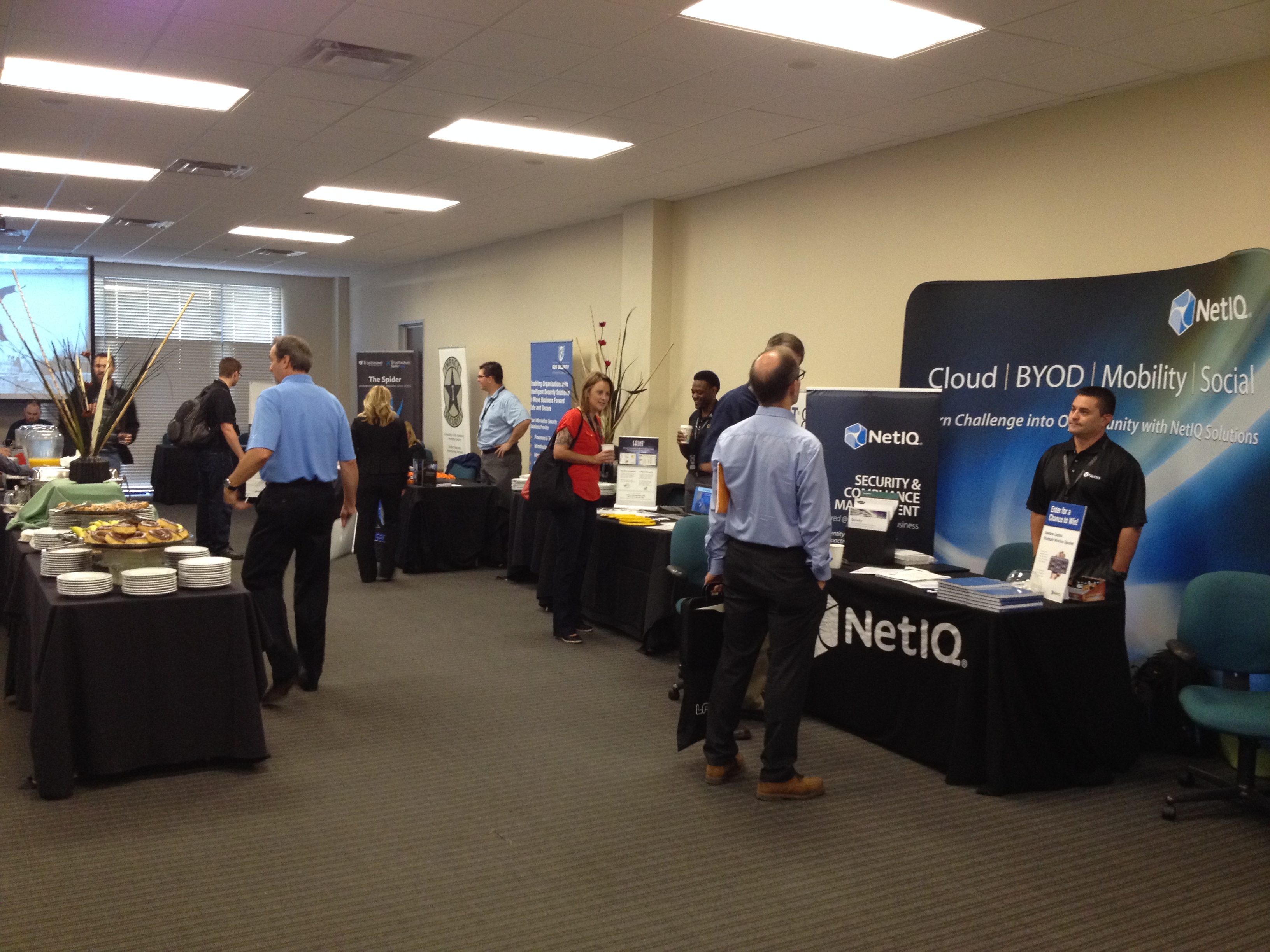
  • Impact Security
  • NetIQ
  • SWAMP

You can also see a bunch of great pictures from the event courtesy Catherine Clark!

Blindspots

The keynote this morning is from Robert “RSnake” Hansen, now of White Hat. It’s about blind spots we all have in security.  Don’t take this as an attack, be self reflective.

Blindspot #1 – Network & Host Security

Internetworked computers is a very complex system and few of us 100% understand every step and part of it.

How many people do network segregation, have their firewall on an admin network, use something more secure than a default Linux install for their webservers, harden their kernel, log off-host and log beyond standard logs? These are all cheap and useful.

Like STS, it was only considered very tightly and the privacy considerations weren’t identified.

Blindspot #2 – Travel and OPSEC

Security used to be more of a game. Now the internet has become militarized. Don’t travel with your laptop. Because – secret reasons I’ll tell you if you ask. (?)

[Ed. Apparently I’m not security 3l33t enough to know what this is about, he really didn’t say.]

Blindspot #3 – Adversaries

You seed to be able to see things from “both sides” and know your adversary (personally ideally). Some of them want to talk! Don’t send them to jail, talk and learn. Yes, you can.

Blindspot #4 – Target Fixation

Vulnerabilities aren’t created equal. Severities vary. DREAD calculations vary widely. Don’t trust a scanner’s DREAD. Gut check but then do it on paper because your gut is often not correct. Often we have “really bad!” vulnerabilities we obsess about that aren’t really that severe.

Download Fierce to do DNS enumeration, do bing IP search, nmap/masscan/unicornscan for open ports.

Blindspot #5 – Compliance vs Security

These aren’t very closely related.  Compliance gets you little badges and placated customers. Security actually protects your systems and data. Some people exercise willful negligence when they choose compliance over security. Compliance also pulls spend to areas that don’t help security. Compliance doesn’t care about what hackers do and it doesn’t evolve quickly.

Blindspot #6 – The Consumer

Consumers don’t really understand the most rudimentary basics of how the Internet works and really don’t understand the security risks of anything they do. They’re not bad or stupid but they can’t be expected to make well informed decisions. So don’t make security opt in.

We the security industry are not pro-consumer – we’re pro-business. Therefore we may be the first ones against the wall when the revolution comes. Give them their privacy now.

So pick one, work on it, we’ll be less blind!

Big Data, Little Security?

By Manoj Tripathi from PROS in Houston.

Big Data is still emerging and doesn’t have the mature security controls that older data platforms have.

Big data is a solution to needs for high volume, high velocity, and/or rich variety of data.  Often distributed, resilient, and not hardware constrained (but sometimes is).

Hadoop is really a framework, with HDFS, Zookeeper, mapreduce, pig/hive, hbase (or cassandra?). He’ll talk a lot about this framework because it’s so ubiquitous.

NoSQL – Cassandra (eventually consistent, highly available, partition tolerant), MongoDB (consistent, partition tolerant).

Security is an afterthought in Big Data.  It can be hard to identify sensitive data (schemaless). He says there’s provenance issues and enhanced insider attacks but I don’t know… Well, if you consider “Big Data” as just large mineable data separate from the actual technology, then sure, aggregate data insights are more valuable to steal… His provenance concern is that data is coming from less secured items like phones/sensors but that’s a bit of a strawman, the data sources for random smaller RDBMSes aren’t all high security either…

Due to the distributed architecture of hadoop etc. there’s a large attack surface. Plus Hadoop has multiple communication protocols, auth mechanisms, endpoint types… Most default settings in Hadoop on all of these are “no security” and you can easily bypass most security mechanisms, spoof, accidentally delete data… Anonymous access, username in URL, no perm checking, service level auth disabled, etc.

Hadoop added Kerberos support, this helps a lot. You can encrypt data in transit, use SSL on the admin dashboards.

But – it’s hard to configure, and enterprises might not like “another” auth infrastructure. It also has preconditions like no root access to some machines and no communication over untrusted networks. And it has a lot of insecure-by-default choices itself (symmetric keys, http SPNEGO has to be turned on in browsers, Oozie user is a super-user with auth disabled by default). No encryption at rest Kerberos RPC is unencrypted. Etc, etc, etc.

To Cassandra.  Same deal. CLI has no auth by default. Insecure protocols.

NoSQL vulns – injections just like with SQL. Sensitive data is copied to various places, you can add new attributes to column families.

Practical Steps To Secure It

Cassandra – write your own authorization/authentication plugin.  [Ed. Really?] But this has keyspace and column family granularity only. 1.2 has internal auth. Enable node-node and client-node encryption. If you do this at least it’s not naiively vulnerable. Also, use disk support for encryption.

Hadoop – basically wait for Project Rhino. Encryption, key mgmt, token based unified auth, cell level auth in hbase. Do threat modeling. Eliminate sensitive data, use field level encryption for sensitive fields, use OS or file level encryption mechanisms. Basically, run it in a secured environment or you’re in trouble.  Apache Knox can enforece a single point of access for auth to Hadoop services but has scalability/reliability issues. Can turn on kerberos stuff if you have to…

Also. commercial hadoop/cassandra have more options.

Leave a comment

Filed under Conferences, Security

LASCON 2013 Report – First Afternoon

We move into the afternoon of LASCON. The vendor room was all abuzz, complete with lockpicking village.

IMG_1477IMG_1478

Stupid Webappsec Tricks

Zane Lackey, Security Engineer Manager from Etsy (@zanelackey)

XSS

Data driven security – look at your data instead of using your presuppositions about how attacks work.

Overwrite common methods but only phone home on interesting payloads.

8477 XSS attempts with mostly alert(), prompt(), confirm() (or multiples thereof). The payloads are mostly what you’d expect, “XSS,” document.cookie, integers (from scanners). Note you can’t match on “document.cookie” because it’ll already be expanded, so look for your domains, unique cookies, etc.

What else detects XSS well?  Chrome’s XSS Auditor. Works great.  But it can defend the user but doesn’t fix the XSS.

Server side attempt –

  1. Scan input for HTML esscapes/tag creation.
  2. If found, set flag to true and create array of hostile input.
  3. At output time, check flag, see if any hostile input is being output as valid HTML.
  4. If hostile input is being output, alert!

Need to fail open, stripping will break your app… And it should take you 20 minutes to push to production so detect to fix is a short path!

SQL Injection

These are attack chains that can be instrumented. Detection step then exploit step.

Alert on SQL syntax errors showing up in your application today. It’s a bug even if it’s not an exploit.

Watch logs for unique sensitive db table names in requests.  Occasional false positives are OK.

A SQL injection exploit response will be huge sized, often larger than is normal, detect that. Whitelist stuff that is supposed to give huge responses.

The more alerts you have in an attack chain the more visibility you have, but false positives happen. But if it’s happening in order down the chain, it’s probably not false.

“Temporary” debug stuff is permanent. How do you find this automatically? Access logs.

Map access logs to code paths. Endpoints that don’t get requests are anomalous. Alert off it then go take it out.

Attacker Trix

Cheapest way to find webapp vulns – Automation. Your best attackers are doing it manually anyway, but may as well beat out the kiddies. Break off-the-shelf scanners. They give off strong detection signals. User agents, request patterns, requests for stuff that doesn’t exist (*.asp or php on a Java site, for example).

Blocking IPs is easy but dangerous. You’ll break lots of legit things. IPs are not a strong correlation to identity.

  1. Classify a request as being from a scanner
  2. If yes, weight based on confidence
  3. Feed request into rate limiter (see Nick G’s rate limiting at scale talk) and drop if above threshold. They return a 439 “Request Not Handmade” 🙂

This doesn’t impact browsing but does scripting. Set your thresholds high; allows for false positives but a scanner will definitely peg it.

Be ready for the weirdness that is the Internet! Tried auto-banning accounts that do scanning. They saw 437 scanners over the last week and only 10 were authenticated and 5 were false positives. Browser plugins is our guess. So don’t auto-ban.

Attacks don’t always happen like you’d expect.  Look at the data before you make decisions. Get the instrumentation you need to make those decisions.

“Run a bug bounty program and the Internet shows up!”

And of course you can then insert false data sets to screw with people and increase the cost of attack.

We don’t run scanners of our own because it’s a time sink and requires manual babysitting. We have taken WAF concepts and build them into the apps; since we deploy 30x/day we don’t need the “coverage in the meanwhile” functionality they provide.

Stalking a City for Fun and Frivolity

By Brendon O’Connor, CTO of Malice Afterthought and law student. About CreepyDOL wifi surveillance. He was wearing a kilt and started out by telling us we’d “lost the mandate of heaven.” Why is this? Well…

Everything leaks too much data. Privacy has been disregarded. Fundamental changes are needed to fix this. We need to democratize security – the government is the worst way to do this.

Especially the case of the US persecuting legitimate security researches like Weev for doing things like accessing public information on Web sites.

Wireless.  Your devices advertise networks they know for all our convenience. His little doodads find your probe list of wifi locations and gps location. Now we need a distributed way of doing this on a large scale with no centralized control. Academic sensor networks are kinda like this, but expensive. Hence, the F-BOMB hardware gizmo.

Raspberry Pi based, 5W, $57.08. Uses connection to municipal wifi to phone home, with automatic portal-clickthrough. Reticle, leaderless command and control software. Uses TOR to go out.

CreepyDOL is distribute computation for distributed systems. Want to digest on the nodes to minimize net traffic. Centralized querying for centralized questions only.  Filters include Nosiness, Observation, and Mining. Visualization using Unity (the game engine). Oh look, you can see a map mashup of people wandering around and click on them and find their name and other useful info.

Bottom line is that all these technologies leak info about you like it’s going out of style and it’s pretty simple to get Orwellian levels of visibility on you for one low price.

Gauntlt

I missed this in favor of the next talk; I’ve seen about a dozen gauntlt presentations over time since I know James, but here’s the slides! Integrate security into your CI pipeline you freaks!

Penetration Testing: The Other Stuff

David Hughes, OWASP Austin president and Red Team analyst for GM.

This started as being about organizational skills… It’s general tips on making your life as a pen tester easier.

  • Clients aren’t always right about their environment and scope creep can happen.
  • Don’t assume you’ll have Internet, there’ll be proxies…
  • Prep your tools and do updates and test it ahead of time.
  • Rehearse your toolchain
  • Title your terminals
  • Use mind maps (Freemind), outline tools (NoteCase Pro) to organize tools, systems
  • HTTP-Screenshot module does screenshots as nmap scans
  • Use output options or pipe to a file
  • Reporting – keep organized, do it as you go, use ASCIIdoc to take text to pdf
  • Do things the easy way – look for low hanging fruit. DEfault credentials, bad passwords, cleartext, social engineering, dumpster diving, open wireless. Easy stuff is higher risk and the client cares more than esoteric crap.
  • Don’t rush recon, look for clues, broken windows
  • Have a plan (PTS framework) but range off as needed
  • Protect your customer’s data
  • Encrypt your stuff
  • Have backups
  • Learn and use a scripting language
  • Don’t rub it in with the client
  • Get involved with the community!

And that’s everything but the drinking… Time for happy hour and the mechanical bull!

Here’s some pictures of the volunteers hard at work, the speakers’ green room (there were chair massages there in the afternoon!), and organizer Josh Sokol with Robert “RSnake” Hansen!

IMG_1479 IMG_1480 IMG_1476

Leave a comment

Filed under Conferences, Security